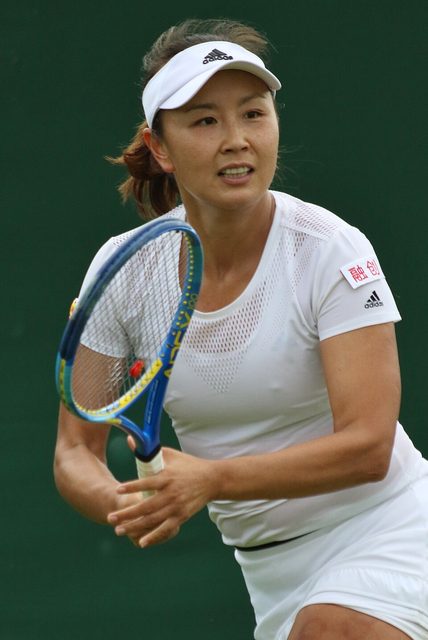
Chinese player ranked world No. 1, in doubles, February 2014
2
Major doubles titles with Hsieh Su-wei: Wimbledon 2013, Roland Garros 2014
96
Minutes taken to win the 2013 Wimbledon final
14
Career-high singles ranking, August 2011
3
Olympic Games, 2008, 2012 and 2016
Playing career
Peng Shuai was born in Xiangtan, Hunan, on 8 January 1986 and was introduced to tennis at eight by an uncle who coached. She hit with two hands on both forehand and backhand, a style she and Hsieh Su-wei said they adopted because they were too small to hold a racket with one hand as children. She played for the Tianjin team, reached a career-high singles ranking of No. 14 in August 2011, won the Asian Games singles and team gold in 2010, and in 2014 reached the US Open singles semi-finals.
Doubles brought her biggest titles. She and Hsieh first played together as teenagers, split when they turned professional and reunited in 2008. They won Wimbledon in 2013 and Roland Garros in 2014, and in February 2014 Peng became world No. 1 in doubles, the first Chinese player to top either ranking. She won 23 tour-level doubles titles in all, among them Nottingham on grass in 2016 with Andrea Hlaváčková, and played three Olympics, finishing fifth in the 2012 doubles with Zheng Jie.
Her last tour match was in Qatar in February 2020. In November 2021 she posted an accusation of sexual assault against China's former vice-premier Zhang Gaoli on social media; the post was removed, and in December 2021 the WTA suspended its tournaments in China, citing concern for her safety and freedom. WTA events returned to China in 2023.
On grass
Wimbledon 2013 final
Seeded eighth with Hsieh Su-wei, beat the 12th seeds Ashleigh Barty and Casey Dellacqua 7-6 (7-1), 6-1 in 96 minutes on Centre Court; the first major title for both
Nottingham 2016
With Andrea Hlaváčková, beat Gabriela Dabrowski and Yang Zhaoxuan 7-5, 3-6, 10-7 in the final at the Nottingham Tennis Centre
Wimbledon 2009 singles
Lost in the second round to the 11th seed Agnieszka Radwańska after three and a half hours, having saved five match points
Leading grass titles only: the grass majors, tour-level grass events since 1968 and the leading grass championships before 1968. † single source; ‡ sources disagree. Roll of champions
"This is a really special time."
Anecdotes
The person behind the player.
Xiangtan
An uncle's sport
She began at eight, introduced by an uncle who was a coach. A doubles partner, Laura Siegemund, later described her as "very determined" on court and, off it, "a sweet person, more introverted, more quiet", who "was always up to hit".
Peng and Hsieh played together as teenage amateurs and split when they turned professional. At the 2008 US Open Hsieh asked Peng whether she wanted to team up again; they won their first 11 matches together, with titles in Bali and Sydney.
Both Peng and Hsieh hit two-handed on both wings. Peng explained that they had started that way because, as small children, they could not hold the racket with one hand.