Wimbledon singles finals: lost 1949 and 1952, won 1954
58
Games in the 1954 final, the longest Wimbledon men's final until the mid-1970s
93
Games in his 1953 third-round win over Budge Patty
17
Wimbledon appearances, under four national identities
1914
Last left-handed men's champion before him, Norman Brookes
Playing career
Jaroslav Drobný was born in Prague on 12 October 1921 and grew up at a tennis club on an island in the Vltava, where his father worked and lived on site; he earned his first racquet money as a ball boy. In winter the courts were flooded for skating, and he became as good at ice hockey as at tennis. He first played Wimbledon in 1938, at 16, and in 1946 beat Jack Kramer there on the way to the semi-finals.
He won the world ice hockey title with Czechoslovakia in 1947, scoring 15 goals, and Olympic silver at St Moritz in 1948, while reaching tennis finals in Paris and London. In July 1949, at a tournament in Gstaad, he and his Davis Cup team-mate Vladimír Černík refused to go home. Stateless, he was turned down for Swiss, American and Australian papers before Egypt gave him citizenship.
As an Egyptian he won the French Championships in 1951 and 1952, three Italian titles and, in 1954, Wimbledon, beating Ken Rosewall 13-11, 4-6, 6-2, 9-7. He was ranked world No. 1 that year and won more than 130 singles titles in all. He settled in England with his wife, Rita, became a British citizen in 1959 and played his last Wimbledon for Britain in 1960. He later ran a sports shop in South Kensington, published his autobiography, Champion in Exile, in 1955, and died in London on 13 September 2001. He entered the International Tennis Hall of Fame in 1983.
On grass
Wimbledon finals
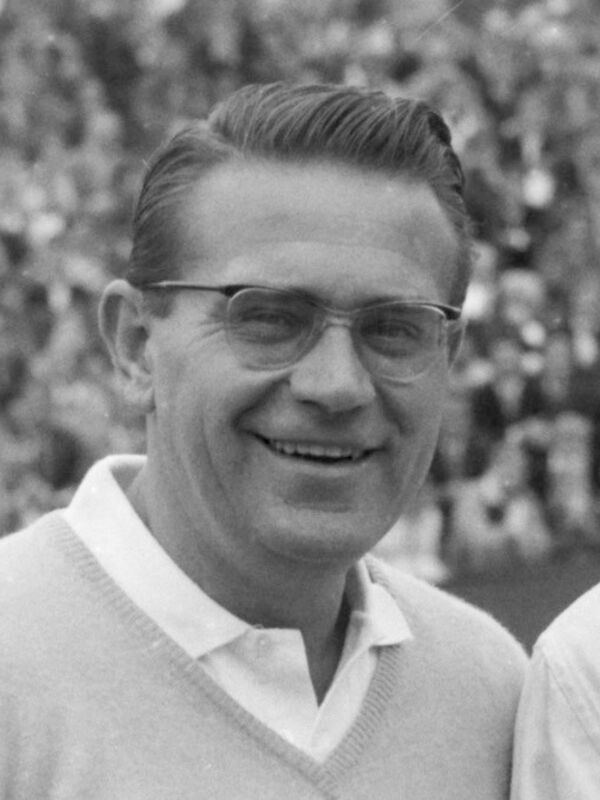
1949: lost to Ted Schroeder 3-6, 6-0, 6-3, 4-6, 6-4. 1952: lost to Frank Sedgman 4-6, 6-2, 6-3, 6-2. 1954: beat Ken Rosewall 13-11, 4-6, 6-2, 9-7, the first left-hander to win since Norman Brookes in 1914 and the only man to win the singles wearing glasses
Wimbledon 1953, third round
Beat Budge Patty 8-6, 16-18, 3-6, 8-6, 12-10 after saving six match points, in 4 hours 20 minutes from 5 pm to 9.20 pm, then the longest continuous match on record. Exhausted, he lost the semi-final in straight sets to the unseeded Kurt Nielsen
Wimbledon 1946
Beat Jack Kramer in the fourth round in a five-set match with one set of 17-15, then lost in the semi-finals
Victorian Championships 1949
Won at Kooyong, Melbourne, beating Bill Sidwell 6-4, 6-3, 11-9, months after his defection
Leading grass titles only: the grass majors, tour-level grass events since 1968 and the leading grass championships before 1968. † single source; ‡ sources disagree. Roll of champions
"Jaroslav Drobný at Wimbledon in 1946 was my toughest opponent. It was a five set match that took about three hours. One set went 17-15. I had blisters on my hands and had to wear a golf glove."
Anecdotes
The person behind the player.
Prague, 1920s and 1930s
Raised at the club
His father, looking for a home for his family, took a job at a tennis club on an island in the Vltava that came with living quarters on site, and kept it for the rest of his working life. The boy learned the game there, bought his first racquet with ball-boy money and skated on the flooded courts in winter. Decades later Lady Luisa Abrahams recalled that he had been her ball boy when she was a young woman in Prague.
He played centre for Czechoslovakia, scoring 15 goals as they won the 1947 world title in Prague and nine at the 1948 Olympics. A hockey injury damaged his eyesight, and he played tennis for the rest of his career in tinted prescription glasses. The Boston Bruins offered him $20,000 to become the first European in the NHL; he turned it down.
Treated by the new communist government as a prize asset, with a flat, a car and a sinecure, he defected at a tournament in Gstaad with Vladimír Černík. He said he most hated being used as "the cheapest available form of propaganda". No Czech tennis player was allowed to travel to the West for five years afterwards.
Refused papers by Switzerland, the United States and Australia, he was offered Egyptian citizenship after Princess Faiza persuaded her brother, King Farouk. He had played the Egyptian championships regularly. He represented Egypt at Wimbledon from 1950 to 1959, so competing there under four national identities: Czechoslovakia, the Protectorate of Bohemia and Moravia, Egypt and Great Britain.
His third-round match with Budge Patty began at 5 pm and ended at 9.20 pm. Patty held six match points and lost 12-10 in the fifth. "I could hardly see a thing and I was so tired I barely knew where I was," Patty told The Daily Telegraph in 2000. Drobný had nothing left for the semi-final.
Smaller, stockier and bespectacled, he looked nothing like the Americans and Australians who then ruled the game, and the British public took to him. The Pathé newsreel of the 1954 final shows almost as much of his wife, Rita, willing him on from the stands as it does of the tennis. He valued the title partly because it made him a permanent member of the All England Club.