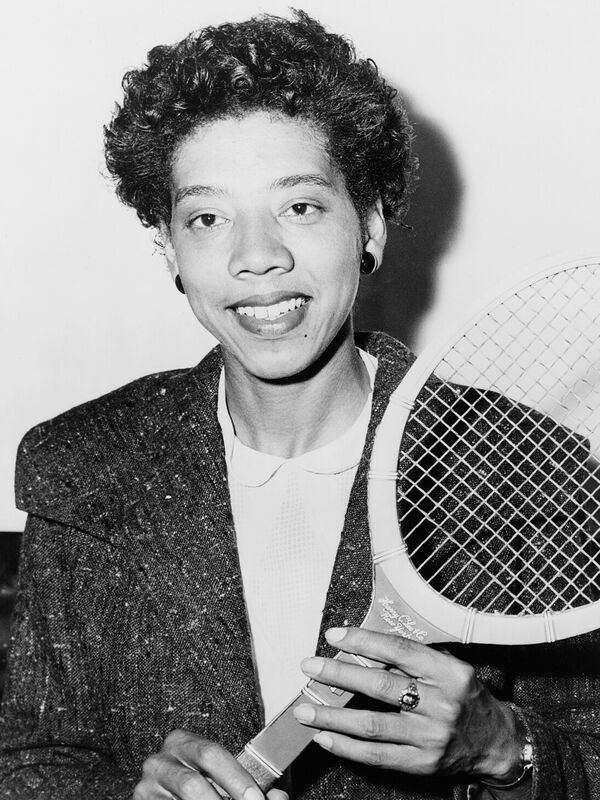
Born on 25 August 1927 in Silver, South Carolina, Gibson moved with her family to Harlem in 1930 and was New York City women's paddle tennis champion at 12, on a Police Athletic League play street. Neighbours paid for a junior membership at the Cosmopolitan Tennis Club in 1940, and the doctors Walter Johnson and Hubert Eaton became her mentors. Alice Marble's campaign helped open the US Championships to her in 1950, and her French title in 1956 made her the first Black player to win a major. She won 11 major titles: five singles, five doubles and one mixed. She left amateur tennis in 1958, played exhibitions before Harlem Globetrotters games, joined the LPGA in 1964 as its first Black member, entered the Hall of Fame in 1971 and died in East Orange, New Jersey, on 28 September 2003.
1956: lost to Shirley Fry 3-6, 4-6. 1957: beat Louise Brough 6-3, 6-2. 1958: beat Darlene Hard 3-6, 6-1, 6-2, the only one of her five major singles titles decided in three sets
Wimbledon doubles
1956 with Angela Buxton, 1957 with Darlene Hard, 1958 with Maria Bueno. Mixed doubles finalist in each of those years
Other grass major doubles
Australian doubles 1957 with Shirley Fry; US mixed 1957 with Kurt Nielsen
Wimbledon debut
1951: the first African-American to play at Wimbledon; lost to Beverly Baker in the third round
Leading grass titles only: the grass majors, tour-level grass events since 1968 and the leading grass championships before 1968. † single source; ‡ sources disagree. Roll of champions
"Shaking hands with the Queen of England was a long way away from being forced to sit in the colored section of the bus."
Anecdotes
The person behind the player.
Harlem, 1939
The play street
She learned on a Police Athletic League play street in Harlem and was the city's women's paddle tennis champion by 12. Proper tennis did not appeal at first: "I kept wanting to fight the other player every time I started to lose a match." In 1943 she was runner-up as a singer in the amateur contest at the Apollo in Harlem.
On 25 August 1950, her 23rd birthday, she became the first African-American to play the US Championships. In the second round she led Louise Brough 7-6 in the third set when rain and lightning stopped play. Brough won the set 9-7 the next day.
Her partner was Angela Buxton, a British Jewish player turned away by London clubs and left out of the top British pairings. Together they won the French and Wimbledon doubles, the first Wimbledon titles for a British Jewish player and an African-American. One headline read "Minorities win". Decades later Buxton raised money to help Gibson through hard times.
On a hot 6 July she beat Darlene Hard in the final, won the doubles with Hard as well, and received a gold plate from the Queen. New York gave her a ticker-tape parade on her return, and she told the crowd: "This victory was won through the help of all your encouragement and your well wishes."
Days after she had shaken hands with the Queen, hotels in Oak Park and River Forest, Illinois, refused her a room, and the Ambassador East in Chicago would not host a luncheon in her honour in its Pump Room. At a Denver country club the year before, objections to her presence at a dance faded when she sang on stage.
Cast in John Ford's film The Horse Soldiers, she refused to deliver her lines in a stereotyped dialect written for her character. Ford agreed and changed the script. That year, having left amateur tennis, she also played exhibitions with Karol Fageros before Harlem Globetrotters games.