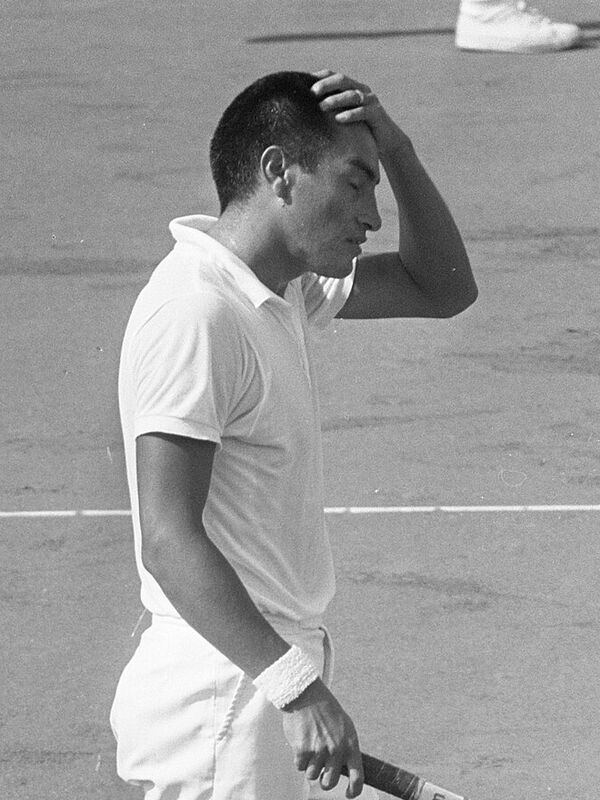
Points he won in the 1958 Davis Cup final, all three the US needed
2
Major singles titles in 1959, Australia and Wimbledon
71
Minutes for the 1959 Wimbledon final against Rod Laver
7-2
Davis Cup record, 1958 and 1959
No. 2
World amateur ranking in 1959
Playing career
Alejandro Olmedo was born in Arequipa, Peru, in 1936, the son of a club caretaker and tennis professional, and began playing at nine with his father's racquet. An American coach in Peru, Stanley Singer, spotted him, and local supporters raised $700 to send him to the United States in 1954. He went by boat to Havana, by plane to Miami and by bus to Los Angeles, where he worked in a tennis shop, learned English at night school and was taken up by Perry T. Jones at the Los Angeles Tennis Club. After a spell at Modesto Junior College he went to the University of Southern California under George Toley and won the NCAA singles and doubles titles in 1956 and 1958.
Peru had no Davis Cup team, and Olmedo had lived in the United States for more than three years, so Jones, the US captain, picked him for 1958. He was not a US citizen, and the choice was attacked in the American press. In the Challenge Round on grass at Milton, Brisbane, he won both his singles and the doubles with Ham Richardson to take the Cup from Australia. In 1959 he won the Australian Championships in Adelaide, beating Neale Fraser, and Wimbledon, beating Rod Laver in the final, and lost the US final at Forest Hills to Fraser. Australia regained the Davis Cup at Forest Hills that year.
He turned professional in 1960, joined Jack Kramer's tour and won the US Pro title that year, beating Tony Trabert in the final. He stopped touring in 1965 and became the teaching professional at the Beverly Hills Hotel, where he worked for some 40 years. He entered the Hall of Fame in 1987 and died of brain cancer in Los Angeles on 9 December 2020, aged 84.
On grass
Davis Cup 1958, Brisbane
Beat Mal Anderson 8-6, 2-6, 9-7, 8-6. With Ham Richardson beat Anderson and Neale Fraser 10-12, 3-6, 16-14, 6-3, 7-5, an 82-game match of about four hours. Beat Ashley Cooper, the world No. 1, 6-3, 4-6, 6-4, 8-6 to win the Cup
Wimbledon 1959
Dropped two sets in the tournament and none in the last two rounds, beating Roy Emerson in the semi-final and Rod Laver 6-4, 6-3, 6-4 in the final
Australian final 1959
Beat Neale Fraser 6-1, 6-2, 3-6, 6-3 at Memorial Drive, Adelaide
US final 1959
Lost to Neale Fraser at Forest Hills 6-3, 5-7, 6-2, 6-4
US Open 1971
At 35, lost in five sets on the Forest Hills grandstand to Jimmy Connors, who came from two sets down on his 19th birthday
Leading grass titles only: the grass majors, tour-level grass events since 1968 and the leading grass championships before 1968. † single source; ‡ sources disagree. Roll of champions
"I told Captain not to worry. I would win. He was nervous. I had to give him confidence."
Anecdotes
The person behind the player.
Brisbane, December 1958
The superchief
When the Cup was won he ran to the dressing room shouting, "We did it, Cap. We won." Jones answered, "By golly, we did." Among the telegrams was one from the actor Kirk Douglas: "Now you are more than a chief. You are a superchief."
Overnight rain left the Milton grass extremely slippery, and Olmedo and Mal Anderson both played their singles in spiked shoes. It was the first time Olmedo had worn spikes. The shoes are now in the International Tennis Hall of Fame museum in Newport.
He was known as The Chief, a reference to his Inca ancestry and appearance. Sports Illustrated in 1959 described a young man fond of western films and a vintage Mercury, living in a two-room flat; one friend insisted, "Alex is not a wolf, he just falls in love with every girl he sees."
Two weeks before the Davis Cup defence he lost to a lower-ranked player at the national clay court championships, and the USLTA threatened to suspend him for not trying. His answer, years later: "I didn't want to return to the States to play on clay. I needed to rest before my Davis Cup defense." Australia regained the Cup at Forest Hills.
His pupils included Katharine Hepburn, who talked to him about her life with Spencer Tracy after their lessons, Charlton Heston, Robert Duvall, Chevy Chase and Jon Lovitz. Of the hotel post he said, "It's the first and only job I ever had."