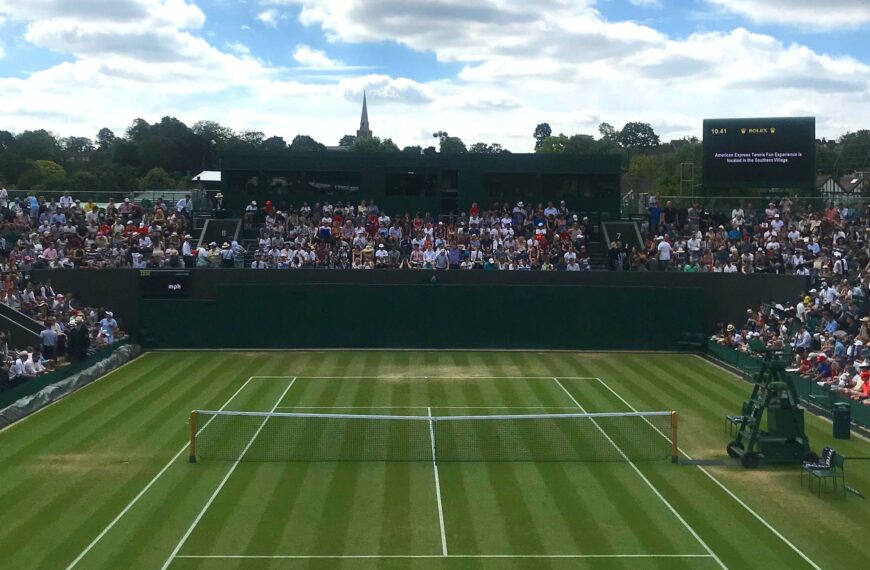
End-of-season renovation restores a grass tennis court after a summer of wear: the court is mown down, scarified, aerated, overseeded, top dressed, levelled, fed and watered, in roughly that order. It is done as soon as possible after the last match, while the soil is still warm enough for seed to germinate; seed suppliers advise a soil temperature of at least 10°C (50°F). The court then rests until the next season so the new grass can establish.
Why renovate straight after the last match
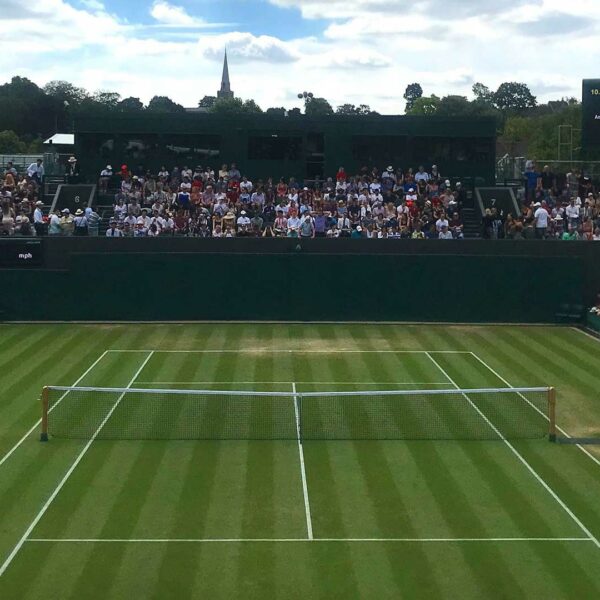
A season of play leaves bare baselines, thin service areas, compacted soil and a build-up of thatch. Grass recovers only while it is growing, and ryegrass seed needs warm, moist soil. Every week of delay after the season ends shortens the recovery period before cold weather slows growth. Wimbledon renovates all its courts in August and September each year, immediately after The Championships. Clubs that keep playing well into autumn trade those extra weeks of tennis for a thinner court the following spring.
Timing by hemisphere and soil temperature
Seed germination
Most grass courts in the United Kingdom, and many elsewhere, are sown with perennial ryegrass; Wimbledon has used 100 per cent perennial ryegrass since 2001. Barenbrug’s sowing guidance advises sowing standard mixtures when the soil temperature is at least 10°C. Purdue University’s turf programme gives an optimum germination temperature range for perennial ryegrass of about 20 to 30°C (68 to 86°F). In good conditions, with enough moisture, seed germinates in 7 to 14 days. A soil thermometer gives a clearer picture than air temperature.
United Kingdom and northern Europe
- Renovate from late August to mid-September, as soon as play finishes.
- Soil is usually warm enough into September; germination slows sharply as soil cools in October.
- If the soil is dry, irrigation will be needed for the seed; Pitchcare’s tennis diaries note that the ground generally becomes moist enough for deep aeration by late October.
Australia and New Zealand
- Ryegrass courts. Renovate in early autumn as soon as the season ends, while soils are still warm.
- Couch courts. Warm-season couch establishes and recovers only in warm weather, so worn baselines are often replaced with turf rather than seed. At Kooyong in Melbourne, where play runs from November to May, worn couch baselines have been cut out at the end of the season, laid with fresh clay and couch turf, rolled in and left over winter to establish by spring.
For background on grass species, see our guides to the types of grass used for tennis courts and to rye and Bermuda grass.
The standard sequence
1. Assess wear
Walk the court and note the condition before starting. Mark bare baselines, thin service boxes, low spots, weeds and patches of disease or pest damage. Take cores to measure thatch depth, which sets the scarifying depth. Check levels with a straightedge or laser. This assessment decides how much seed, dressing and labour you need.
2. Mow down
Lower the cutting height in stages to clean out the sward. Pitchcare’s renovation guidance suggests taking courts down to about 3 to 4 mm; Germinal suggests 5 to 10 mm at the end of the summer season. Box off all clippings.
3. Scarify
Remove thatch so seed and dressing reach the soil. Pitchcare gives a scarifying depth of 4 to 15 mm, depending on how much thatch needs to come out, usually in two directions, and more on heavily thatched courts. Clear the arisings with blowers, power brushes or a mower with a box. Pitchcare notes that many clubs do not remove enough thatch at renovation.
4. Aerate
Relieve the compaction left by a season of play and rolling.
- Hollow tining to 75 to 100 mm (3 to 4 in) removes cores of soil and thatch; the holes fill with dressing.
- Solid or slit tines to 100 to 200 mm (4 to 8 in) break deeper compaction.
Deep spiking continues through the winter: Pitchcare recommends at least four deep spiking operations from the end of October to January in the United Kingdom. See our guide to aerating your grass court.
5. Overseed
Sow after scarifying and aeration, when the surface is open.
- Pitchcare and Germinal both give a sowing rate of 35 g/m2. Pitchcare puts this at about one 25 kg bag of seed per court.
- Sow in two directions with a spreader for even cover, or use a disc seeder to place seed into the soil.
- Bare baselines may need extra attention, as described in our guide to repairing worn grass tennis courts.
Seed choice matters: a cultivar bred for close mowing and wear will perform better than a general amenity mix. Our guide to grass seed suppliers for grass tennis courts covers what to look for.
6. Top dress
Top dressing covers the seed, fills the scarifying grooves and tine holes, and corrects small surface irregularities.
- Germinal gives a rate of 3 kg/m2. Pitchcare advises allowing about four tonnes of dressing per court.
- Use a loam that matches the existing soil. A sandier or different dressing creates layers that hold water and break rooting.
- Spread evenly, avoiding heaps that smother seed. On a small scale the job is done with shovels and barrows; larger clubs use pedestrian or tractor-mounted dressers.
Wimbledon uses about 200 tonnes of soil each year to level its courts. Our guide to top dressing your grass tennis court explains how to choose and apply a dressing.
7. Level
Work the dressing into the surface with a drag mat, lute or brushes, moving material from high points into hollows. Pitchcare’s tennis diaries describe working material into the sward with luting tools, drag mats or brushes. Brushing also helps the grass stand back up. Repeat until no dressing sits on top of the grass. Deeper hollows need repeated light dressings over time rather than one heavy layer; see our guide to fixing uneven patches on grass courts.
8. Feed
Apply an autumn fertiliser that is low in nitrogen and higher in potassium to support root growth and hardiness without forcing soft leaf growth. Pitchcare gives an example of an NPK 5:5:15 product. Follow the label rate for the product you use. A soil test helps set the balance; see our guide to fertilisers for grass tennis courts.
9. Water
Keep the seedbed moist until the seed has germinated and rooted. Pitchcare’s guidance stresses that the sward must be kept watered after renovation for the seed to germinate. Light, frequent watering is acceptable at this stage only, because the seed sits near the surface; once the grass is established, return to deeper, less frequent irrigation.
After germination and the rest period
- First cuts. Pitchcare advises mowing the new growth with a hover rotary mower at 20 to 25 mm for the first two or three cuts, then holding the courts at 12 to 18 mm through the winter.
- No play. The renovated court should not be played on again that season. In the United Kingdom it rests from September until pre-season preparation begins in spring; Germinal advises pre-season rolling from mid-March onwards.
- Winter care. Continue aeration while the soil is moist, keep leaves off the surface and limit foot traffic in frost or waterlogging. See our guide to protecting grass tennis courts during the off-season.
Renovation checklist
- Book contractors, hire equipment and order seed, dressing and fertiliser before the season ends.
- Record soil temperature; aim for at least 10°C for ryegrass.
- Assess wear, measure thatch and check levels.
- Mow down in stages and box off clippings.
- Scarify to the depth set by the thatch measurement; collect debris.
- Hollow tine or solid tine.
- Overseed at about 35 g/m2.
- Top dress with a compatible loam.
- Lute, drag or brush to level and work dressing in.
- Apply a low-nitrogen autumn fertiliser.
- Keep the seedbed moist until established.
- First cuts at 20 to 25 mm with a hover mower.
- Rest the court until pre-season preparation.
For costing the work, see our guide on budgeting for seasonal repairs. The supplier directory at https://grasstennisclub.com/suppliers/ lists seed, dressing and contractor companies by category.
Key points
- Start renovation as soon as play ends, while soil is still warm.
- Ryegrass needs soil of at least 10°C to germinate reliably; germination takes 7 to 14 days in good conditions.
- Sow at about 35 g/m2 and allow roughly 3 kg/m2, or about four tonnes per court, of compatible dressing.
- Remove enough thatch; it is the step most often skimped.
- Rest the court until the following season.
Sources
- Wimbledon: Media Fact Sheet, Grounds 2023 (AELTC)
- Pitchcare: September Tennis Diary 2020
- Pitchcare: October Tennis Diary 2013
- Pitchcare: October Tennis Diary
- Germinal Amenity: Grass tennis court maintenance
- Barenbrug: Sowing
- Purdue University Turf: Optimum temperatures for seed germination
- Pitchcare Oceania: Nick of time (Kooyong Lawn Tennis Club)