
New: the 12-month grass court maintenance calendar, month by month for temperate, hot and tropical climates, in either hemisphere. Members can also download it as an A3 wall chart for each climate, free.
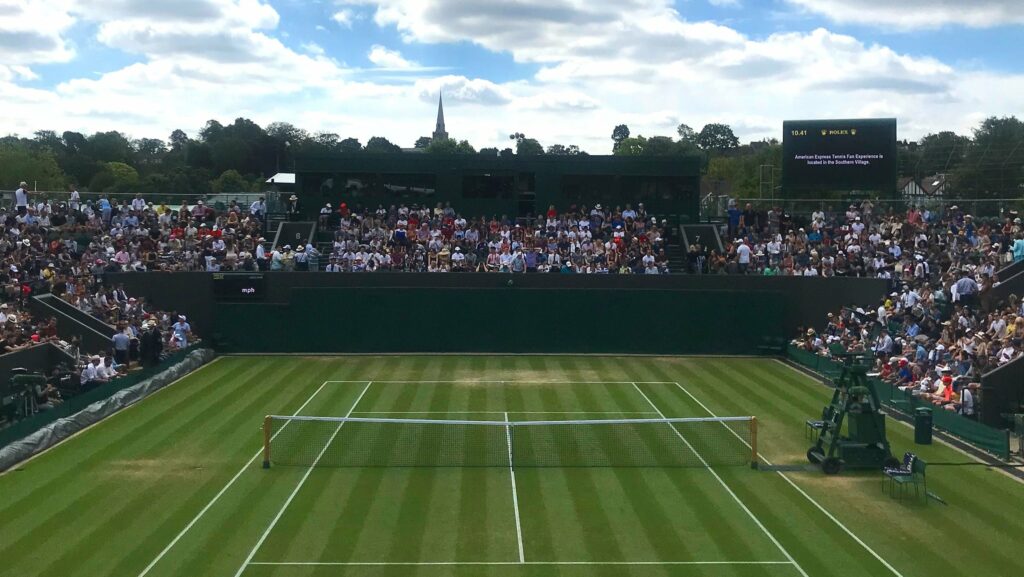
A grass tennis court runs on an annual cycle: a playing season in late spring and summer, an intensive renovation straight after it, and a quieter winter of protection and machinery work. The main variable through the year is mowing height, which drops from a winter height of about 12 to 18 mm (Wimbledon holds 13 mm) to a playing height of about 8 to 10 mm (5/16 to 3/8 in), then falls further for renovation. The calendar below gives northern hemisphere months first, with the southern hemisphere equivalent in brackets; adjust by a few weeks either way for your local climate and soil temperatures.
How to use this calendar
Treat the months as a guide to sequence, not fixed dates. Grass growth follows soil temperature and moisture, so a cold spring or a wet autumn moves every job. Clubs on heavy clay loam soils should be especially cautious about working the surface when it is wet or very dry. The overview of grass court maintenance explains each operation in more depth; this page sets out when they happen.
Two rules apply all year. First, never remove more than a third of the leaf in a single cut. Second, change height gradually: Wimbledon’s groundstaff hold their courts at 13 mm over winter and lower them about 1 mm at a time in spring to reach 8 mm for play.
Month by month
January and February (July and August in the southern hemisphere)
- Mowing: only when the surface is dry and firm enough to carry the mower, with the height held at the winter setting of about 12 to 18 mm. A rotary mower can top the sward and clear debris.
- Rolling: none, other than a very light pass if frost heave has lifted the surface.
- Aeration: complete any deep work early. Pitchcare’s diary advises against aerating clay profiles after January because holes can crack open as the soil dries in spring.
- Covers: keep off-season covers secure and lift them regularly to check for disease.
- Machinery: this is the main servicing window. Have cylinders reground and mowers serviced now, as dealers are busy later.
- Planning: order seed, fertiliser, top dressing and line marking material for the year, and book a soil analysis if one is due.
March (September in the southern hemisphere)
- Mowing: increase frequency as growth starts and begin lowering the height in small steps.
- Rolling: start consolidation rolling from mid-March when soil moisture allows, beginning with a light roller or an unballasted mower roller and rolling across the line of play first.
- Brushing: brush off morning dew regularly to reduce leaf wetness and fungal disease.
- Aeration: switch to surface aeration only, such as a sarrel roller working the top 25 to 30 mm.
- Feeding: apply a spring feed once the soil has warmed and growth is under way, guided by your soil analysis. See the guide to fertilisers for grass tennis courts.
April (October in the southern hemisphere)
- Mowing: two to three cuts a week, continuing to lower towards the playing height of 8 to 10 mm. Mow in different directions to prevent a nap.
- Rolling: continue, working across then along the line of play, only when the soil is neither wet nor dry.
- Scarifying: light verticutting every two weeks or so removes lateral growth before the season.
- Overseeding and top dressing: seed thin or bare areas and apply only a very light top dressing on a dry surface.
- Weeds and pests: check for weeds, worm casts and pest activity.
- Irrigation: test the system and apply a wetting agent early in the season if you use one.
- Equipment: inspect stored nets, posts, seating and scoreboards.
May (November in the southern hemisphere)
- Mowing: reach playing height. Club courts are generally played at 6 to 10 mm depending on the standard of play; Wimbledon plays at 8 mm.
- Marking: complete the first marking out. Pitchcare’s diary sets May as the target for initial marking.
- Opening: courts open once firmness and evenness are acceptable. Firmness can be checked with a Clegg impact hammer.
- Rolling: rolling continues to build firmness before matches.
June and July (December and January in the southern hemisphere)
- Mowing: at least three times a week at about 7 to 8 mm; some clubs cut daily. Brush before mowing.
- Rolling: in-season rolling uses a roller of around 1 to 1.5 tonnes where needed, with Pitchcare’s diary suggesting 6 to 10 hours of rolling a week before matches. Once the surface is consolidated, roll mainly after rain has softened it.
- Watering: water in hot, dry spells, timed so courts are dry for play. Aim for moisture to reach at least 150 mm (6 in) into the rootzone and check with a probe.
- Marking: remark lines as often as play requires; see how to mark lines on grass tennis courts.
- Wear: repair worn baselines with seed and top dressing, and rotate courts in play.
- Covers: keep wet weather covers ready.
August (February in the southern hemisphere)
- Mowing: continue at playing height until the last matches, then raise slightly to relieve stress.
- Preparation: take core samples from each court to measure thatch and organic matter, order renovation materials and check scarifier belts and drives.
- Renovation: clubs that close early start renovation now. Wimbledon renovates its courts in August and September.
September and October (March and April in the southern hemisphere)
This is the renovation window. Air temperatures of around 10 to 12°C still allow seed to establish in October, but earlier work gives the new grass longer to establish before winter.
- Mowing down: lower the height to about 3 to 4 mm to clean out the surface before scarifying.
- Scarifying: scarify to a depth of 4 to 15 mm depending on thatch, usually in two directions, never at right angles to the previous pass. Clear debris with blowers, mowers or brushes.
- Aeration: hollow tine to 75 to 100 mm when thatch is a problem, generally no more than every couple of years; solid or slit tines go deeper, around 100 to 200 mm.
- Top dressing: apply a loam compatible with the existing soil, spread evenly in dry weather and worked in with a lute or drag mat. One seed supplier suggests about 3 kg/m² as a guide.
- Overseeding: sow into grooves or holes for good seed to soil contact. With moisture and warmth, ryegrass germinates in 7 to 14 days.
- Feeding: a low-nitrogen autumn fertiliser, such as NPK 5:5:15, supports the sward into winter.
- Watering: keep the seedbed moist until the new grass establishes.
- After seeding: mow the new growth at about 20 mm with the clippings collected, then settle to the winter height.
November and December (May and June in the southern hemisphere)
- Mowing: only when conditions allow, at the winter height.
- Aeration: pencil or solid tine when the soil is suitable.
- Feeding: an iron-based product can help harden the sward.
- Covers and protection: fit off-season covers where used and keep traffic off frozen or waterlogged turf. See protecting grass courts during the off-season.
- Machinery: clean all equipment, check air filters and book winter servicing.
- Review: record what worked, measure wear, and budget for next year.
Southern hemisphere and warm climates
Australian and New Zealand clubs can shift each northern hemisphere month by six months, as shown above, but the seasons do not map exactly. Southern hemisphere clubs generally play grass through the warmer months and renovate as autumn arrives, and clubs in hot regions may use warm-season grasses with different mowing and feeding needs. The guide to rye and Bermuda grass covers the main species differences.
Key points
- Winter height of cut is about 12 to 18 mm (Wimbledon holds 13 mm); playing height is about 8 to 10 mm; Wimbledon plays at 8 mm.
- Lower and raise height gradually, around 1 mm at a time, and never remove more than a third of the leaf.
- Consolidation rolling starts in spring when soil moisture is right; deep aeration belongs in autumn and early winter.
- Renovate straight after the season: mow down, scarify, aerate, top dress, overseed, feed and water.
- Service machinery in winter and order materials before you need them.
- For materials and machinery, the supplier directory lists companies by category.
Sources
- Wimbledon Media Fact Sheet: Grounds 2023 (AELTC)
- Wimbledon groundstaff reveal the secrets behind the world’s best grass courts (Pitchcare)
- March Tennis Diary 2021 (Pitchcare)
- April Tennis Diary 2022 (Pitchcare)
- June Tennis Diary 2015 (Pitchcare)
- July Tennis Diary 2006 (Pitchcare)
- September Tennis Diary 2020 (Pitchcare)
- October Tennis Diary 2020 (Pitchcare)
- March maintenance at Chapel Allerton Tennis Club (Pitchcare)
- Grass tennis court maintenance (Germinal Amenity)