
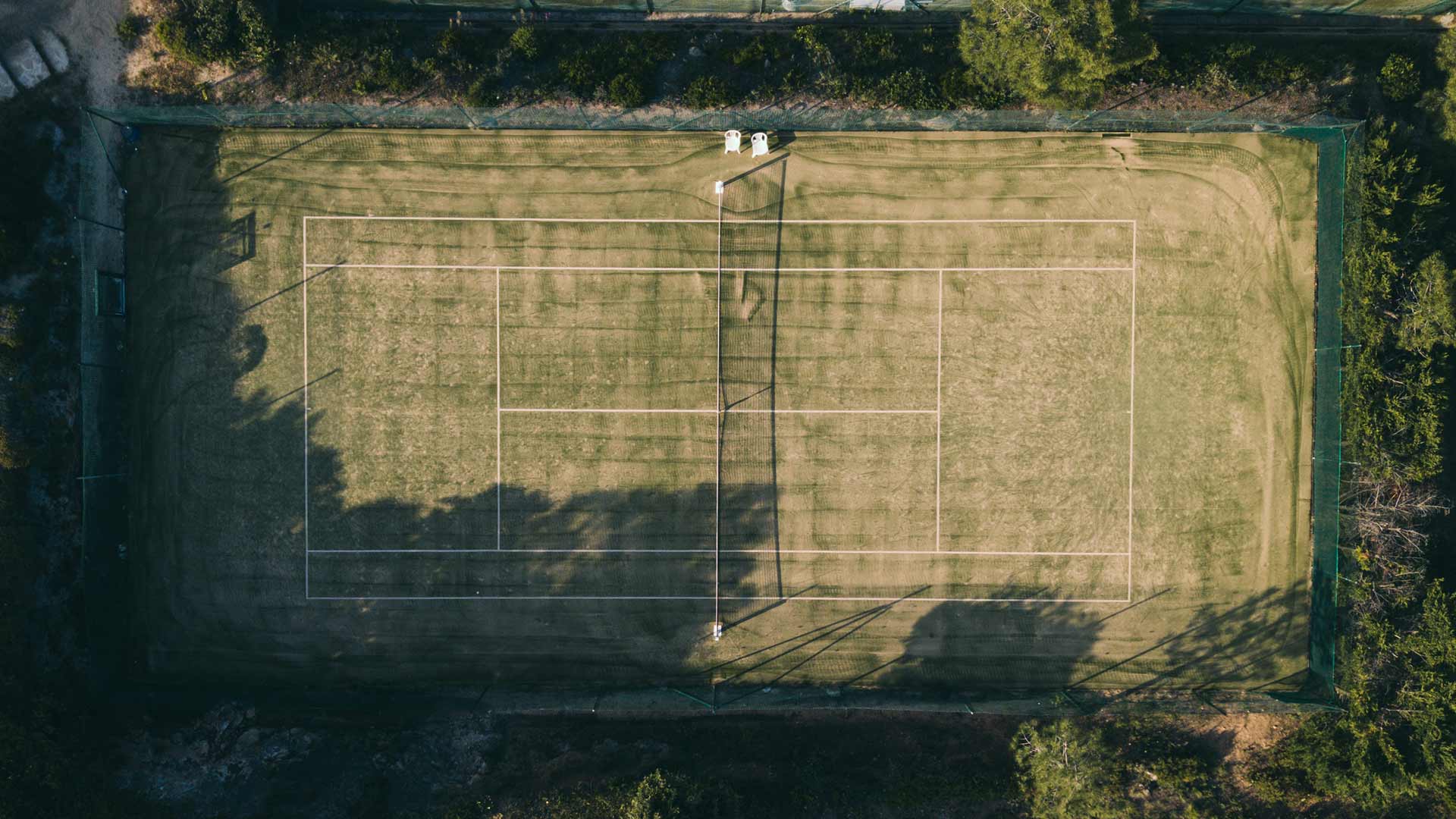
Thatch is the spongy layer of dead and living stems, roots and organic matter that builds up between the grass leaves and the soil. On a grass tennis court it softens and slows the surface, makes the bounce uneven and encourages disease, so it is kept in check with light verticutting through the season and deeper scarifying at end-of-season renovation. The growing habits that create thatch, mainly heavy feeding and light, frequent watering, matter as much as the machinery used to remove it.
What thatch is
Grass constantly produces new shoots, stolons and roots and sheds old ones. On healthy, biologically active soil this material breaks down at roughly the rate it is produced. When production outpaces breakdown, fibrous material accumulates at the surface. A thin layer is normal and gives the turf some resilience under foot. Below that layer, organic matter mixed into the top of the soil is sometimes called mat; it holds water in the same way.
Why thatch matters on a tennis court
A tennis court depends on firm soil close to the surface. Thatch puts a cushion between the ball and that soil.
- Soft surface. The ball lands on fibre rather than on firm soil, so it loses pace and bounces lower and slower.
- Uneven bounce. Thatch rarely builds evenly; patches of deeper fibre give a different bounce from the surrounding turf.
- Moisture held at the surface. Thatch acts like a sponge, staying wet after rain and drying out hard and water-repellent in dry spells.
- Disease and pests. Pitchcare’s guidance on thatch notes that excessive thatch creates a favourable environment for many pests and diseases. Fungal diseases thrive in the damp fibre.
- Shallow roots. Grass roots in the moist thatch rather than the soil beneath, so it is weaker in drought and under wear.
Thatch also affects the work of the rest of the year. Rolling a thatchy court firms the fibre rather than the soil, and top dressing sits on the fibre in layers, creating the root breaks described in our guide to top dressing your grass tennis court.
Measuring thatch
Measure before you choose a programme, because the depth of thatch decides the depth and number of scarifying passes.
Core samples
Cut a small plug or use a soil corer at several places on the court, including the baselines, the service areas and the less-used side areas. Measure the depth of the fibrous, spongy layer between the base of the leaves and the start of firm soil. Pitchcare’s guidance states that thatch becomes a problem for groundsmen when it exceeds 10 mm (3/8 in). Note where the layer is deepest; that is where extra passes are needed.
Laboratory organic matter testing
For a more precise picture, a soil laboratory can measure organic matter content by burning samples taken in layers. One established method takes cores to at least 100 mm (4 in) deep and reports organic matter for each 20 mm layer. Testing every year or two shows whether your programme is reducing organic matter or only holding it steady. Our guide to soil analysis testing laboratories covers what to send and what to ask for.
Verticutting and light scarifying in season
Light, regular work through the growing season stops thatch building up and reduces the size of the job at renovation.
- Verticutting uses vertical blades, often a cassette fitted to a cylinder mower, to slice through lateral stems and lift flattened grass. Pitchcare’s guide to the two techniques gives verticutting depths of about 1 to 9.5 mm and classes anything deeper as scarifying.
- Pitchcare’s tennis diaries suggest light scarification or verticutting at fortnightly intervals before the season. In golf and bowls, verticutting units are often used weekly or fortnightly through the growing season.
- Grooming units on mowers work even more lightly, removing lateral growth just above the soil.
- Keep in-season work shallow. Deep cuts during the playing season leave the surface open and scarred.
- Avoid verticutting in hot, dry spells, when grass recovers slowly. In the United Kingdom, mid-July is often the riskiest time; in Australia, midsummer heat in January and February.
Deep scarifying at renovation
The main thatch removal happens at end-of-season renovation, when the court can recover before the next season.
Depths and passes
- Lower the cutting height first. Pitchcare’s renovation guidance suggests mowing down to about 3 to 4 mm before scarifying so the blades work on the base of the sward.
- Set the scarifier according to the thatch measured. The same guidance gives a scarifying depth of 4 to 15 mm, depending on how much thatch needs to come out.
- Where verticutting has been done regularly through the season, two directions are usually enough. Heavily thatched courts may need several passes in different directions.
- Pitchcare’s renovation guidance advises against scarifying at right angles to the previous pass.
- Check root strength before deep scarifying. If roots are short and weak, a severe pass can lift the turf like a carpet; postpone or reduce the depth.
Pitchcare notes that one of the biggest problems at renovation is that clubs do not remove enough thatch. Deep scarifying looks brutal, but a court that is still green and covered after renovation has usually kept most of its thatch.
Hollow tining
Hollow tining physically removes cores of thatch and soil and is often used alongside scarifying on thatchy courts. Pitchcare’s guidance gives hollow tining depths of 75 to 100 mm (3 to 4 in). The holes are then filled with top dressing, diluting the organic matter. See our guide to aerating your grass court.
Timing in both hemispheres
Renovation scarifying needs warm soil, adequate moisture and a long enough growing period for the grass to recover.
- United Kingdom and northern Europe. Late August to September, straight after the season ends. Wimbledon’s courts are renovated in August and September each year.
- Australia and New Zealand, ryegrass courts. Early autumn after the season ends, while soils are still warm.
- Australia, couch courts. Warm-season couch grass recovers only when it is growing actively. Turf Australia research on couch surfaces links strong couch growth to daily minimum air temperatures above 15°C for five consecutive days, and its trial sites were verticut to 15 mm in late August and in October. Heavy scarifying of couch courts therefore belongs in spring, before play starts, rather than in autumn.
Collecting debris
Scarifying brings up large volumes of fibre. Leaving it on the surface smothers the grass and stops seed and dressing reaching the soil.
- Use a scarifier with a collection box where possible.
- Clear the rest with blowers, vacuums, power brushes or a mower with its box fitted. Our guide to air blowers for grass tennis courts covers this.
- Plan for disposal. Arisings from a single court can fill many bags; compost them away from the courts.
Follow-up: overseeding and top dressing
Scarifying opens the sward, which makes it the right moment to sow.
- Overseed after the final pass and clean-up. Pitchcare and Germinal both give a sowing rate of 35 g/m2 for tennis court renovation.
- Top dress to cover the seed, fill scarifying grooves and dilute organic matter. Use a dressing compatible with the existing soil.
- Brush or drag in the dressing so it falls into the grooves and lifts the grass.
- Water to keep the seedbed moist until the seed establishes. Germination usually takes 7 to 14 days in good conditions.
- A low-nitrogen autumn fertiliser supports recovery without forcing soft growth.
Habits that cause thatch
Machinery treats the symptom. Preventing thatch depends on how the court is fed, watered and mown.
Feeding
Pitchcare’s guidance notes that heavy nitrogen fertilisation drives vigorous growth and more organic matter. Feed little and often to match growth rather than in large doses. See our guide to fertilisers for grass tennis courts.
Irrigation
Light, frequent watering keeps the surface damp, encourages shallow roots and slows breakdown of the fibre. Pitchcare advises deep, infrequent irrigation instead. Our guides on how often to water a grass tennis court and on overwatering explain how to judge it.
Soil pH and biology
Soil that is too acidic or too alkaline slows the microbes that break thatch down. Pitchcare suggests a pH of 6.0 to 7.0 to support them. A soil test every year or two will show where your courts sit.
Mowing
Mow often and at a consistent height so small amounts are removed each time, and box off clippings rather than leaving them on the court. Regular grooming and verticutting units on the mower add light thatch control to routine cutting. See our guide to mowing grass tennis courts.
Key points
- Thatch above about 10 mm softens and slows a court and makes the bounce uneven.
- Measure with core samples before setting scarifier depth; laboratory testing gives organic matter by layer.
- Verticut lightly through the season; scarify deeply only at renovation.
- Renovation scarifying runs 4 to 15 mm deep, usually in two or more directions, never at right angles to the last pass.
- Collect all debris, then overseed, top dress and water.
- Feed modestly, water deeply and less often, and keep pH between 6.0 and 7.0.
The supplier directory at https://grasstennisclub.com/suppliers/ lists scarifier and seed companies by category.
Sources
- Pitchcare: Controlling thatch
- Pitchcare: Top tips, verticutting vs scarifying
- Pitchcare: Testing for organic matter
- Pitchcare: September Tennis Diary 2020
- Pitchcare: October Tennis Diary 2013
- Pitchcare: April Tennis Diary 2011
- Pitchcare: May Tennis Diary 2005
- Grounds Management Association: What is verticutting?
- Germinal Amenity: Grass tennis court maintenance
- Wimbledon: Media Fact Sheet, Grounds 2023 (AELTC)
- Turf Australia: Ryegrass transitioning in couch turf (TU10015)


