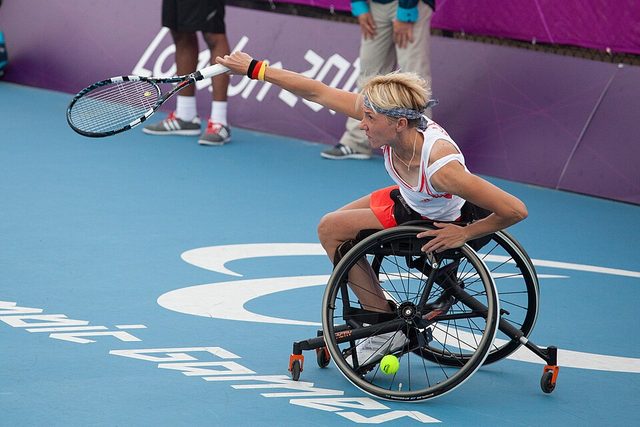
Born in Bielefeld in 1975, Ellerbrock played tennis for 25 years before taking up wheelchair tennis in 2009. Three years later she finished fourth in the singles at the London Paralympics. In 2013 she won the French Open, beating Jiske Griffioen, and on 1 July became world No. 1; she lost the top ranking after the US Open final that year and regained it after winning the 2014 Australian Open against Yui Kamiji. She also reached major singles finals in Melbourne and New York in 2013, at Roland Garros in 2016 and 2017, and at Wimbledon in 2017, and won 26 singles titles in all. Alongside tennis she worked as a teacher of mathematics, biology and sport. She announced her retirement in May 2020, aged 44.
On grass
Major singles finals lost
1: Wimbledon (2017)
Wimbledon singles 2017
Semi-final: beat the world No. 1 Yui Kamiji 7-6, 1-6, 7-6. Final: lost to Diede de Groot 6-0, 6-4
Wimbledon doubles
Runner-up in 2018 with Lucy Shuker, losing to De Groot and Kamiji 6-1, 6-1
"I'm excited because it's going to be my first Champions' Dinner even if I lose."
Anecdotes
The person behind the player.
Wimbledon 2017
Last to arrive
A schoolteacher, she was the last player to reach Wimbledon because of end-of-term duties at home. Her pupils had signed a T-shirt for her, and she wore it on court every day as a lucky charm. She was 41, and reaching the final meant her first Champions' Dinner.
Against Kamiji, who led their meetings 12-2 and had taken the No. 1 ranking from her, she found herself playing too easily at times and decided she had to play clever. Kamiji, she said, did not like her drop shots. She won 7-6 in the third, and later called it one of the best games she ever played.
Teaching mathematics, biology and sport to pupils aged 11 to 18, she spoke openly of the financial pressure of the tour and said she had taken unpaid leave for London 2012. "I had to give up a lot the past years to be able to live my dream of playing wheelchair tennis," she said.
She had planned to finish in Tokyo but retired in May 2020, saying she had "lost the fun on the court at tournaments" and that defending the No. 1 ranking had been harder than reaching it. She took up painting in acrylics, went back to cycling and table tennis, and said she wanted to be a role model for her students.