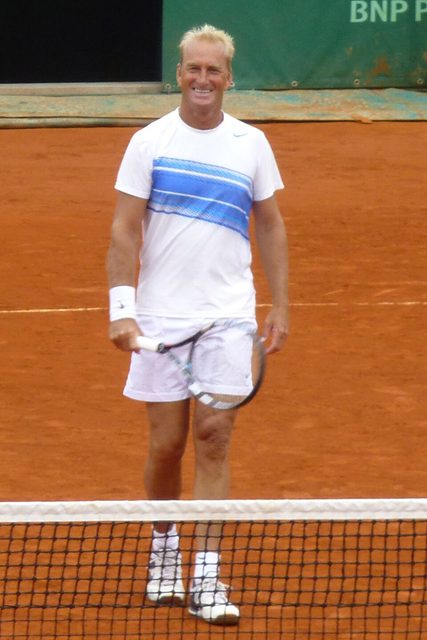
Major doubles titles with Paul McNamee, all on grass
17
Games in the 1982 Wimbledon final, the fewest in a gentlemen's doubles final
14
Of his 19 tour doubles titles won with McNamee
No. 3
Career-high doubles ranking, December 1982
No. 7
Career-high singles ranking, March 1983
Playing career
Peter McNamara was born in Melbourne in 1955 and went to Marcellin College in Bulleen. He turned professional in 1974 and spent the summers of 1977 and 1978 on small clay-court events in France. With his fellow Melburnian Paul McNamee, the pair known as the SuperMacs, he won the Australian Open doubles in 1979 and Wimbledon in 1980 and 1982. Fourteen of his 19 doubles titles came with McNamee, and he reached No. 3 in the doubles rankings in 1982.
He was also a fine singles player. He won five titles, including the German Open in Hamburg in 1981, where he beat Jimmy Connors 7-6, 6-1, 4-6, 6-4, and reached the Australian Open semi-finals in 1980 and the Wimbledon quarter-finals in 1981. The ATP named him Most Improved Player for 1982. In March 1983 he beat Ivan Lendl in the Brussels final and rose to No. 7. In Rotterdam soon afterwards he tore a knee ligament and was off the tour for 21 months; he played on, but the Brussels title was his last in singles. He played Davis Cup for Australia from 1980 to 1982 and in 1985 and 1986.
As a coach he worked at Tennis Australia and from 2009 at the Mouratoglou academy in Paris, with players including Mark Philippoussis, Grigor Dimitrov, Matt Ebden and Wang Qiang, whom he took into the top 20. He died of cancer at his home in Sonthofen, Germany, on 20 July 2019, aged 64.
On grass
Wimbledon 1980
Seeded seventh, beat Bob Lutz and Stan Smith 7-6 (7-5), 6-3, 6-7 (4-7), 6-4 in the final on No. 1 Court, in 149 minutes
Wimbledon 1982
Beat the top seeds and 1979 and 1981 champions Peter Fleming and John McEnroe 6-3, 6-2. Rain cut the final to best of three sets; at 49 minutes and 17 games it is the shortest gentlemen's doubles final on record
Australian Open
Won the 1979 doubles at Kooyong, played in January 1980, beating Cliff Letcher and Paul Kronk 7-6, 6-2. Lost the next final, in January 1981, to Mark Edmondson and Kim Warwick 5-7, 4-6. Singles semi-finalist 1980
Sydney
Won the December grass event with McNamee three years running: 1979 against Steve Docherty and Chris Lewis 7-6, 6-3; 1980 against Vitas Gerulaitis and Brian Gottfried 6-2, 6-4; 1981 against Hank Pfister and John Sadri 6-7, 7-6, 7-6
After the injury
Back from his knee injury, he and McNamee reached the 1985 Wimbledon doubles semi-finals as wild cards. Later they won the 35 and over Invitation Doubles in 1990 and the 45 and over event in 2001; he won the 35 and over again in 1995 with Larry Shiras
Leading grass titles only: the grass majors, tour-level grass events since 1968 and the leading grass championships before 1968. † single source; ‡ sources disagree. Roll of champions
"Macca won well and he lost well, which is so hard"
Anecdotes
The person behind the player.
Melbourne
Fifty years of friendship
After his death McNamee wrote that it was hard to believe that after 50 years of friendship Macca was gone. Of their partnership he said: "We were different personalities but we quickly accepted it was futile trying to change one another."
Instead of the main tour, he spent two summers on small French clay events from Beaulieu on the Mediterranean to La Baule on the Atlantic. "Great for my clay court game," he said later. In 1981 he beat Jimmy Connors to win in Hamburg; McNamee called it unbelievable.
Rain forced the 1982 final to be played over the best of three sets. McNamara and McNamee beat the top seeds Fleming and McEnroe 6-3, 6-2 in 49 minutes, still the shortest gentlemen's doubles final at Wimbledon.
The week after beating Lendl in Brussels, he stepped on an uneven join in the court boards in Rotterdam in his first-round match and twisted his knee. The ATP's chief physio, Bill Norris, found a torn anterior cruciate ligament. He was off the tour for 21 months.
Craig Tiley of Tennis Australia said there was not a player he coached who did not improve. With Wang Qiang he went from outside the top 100 to the top 20 in four years, and he kept his illness private while coaching her at the 2019 Australian Open.