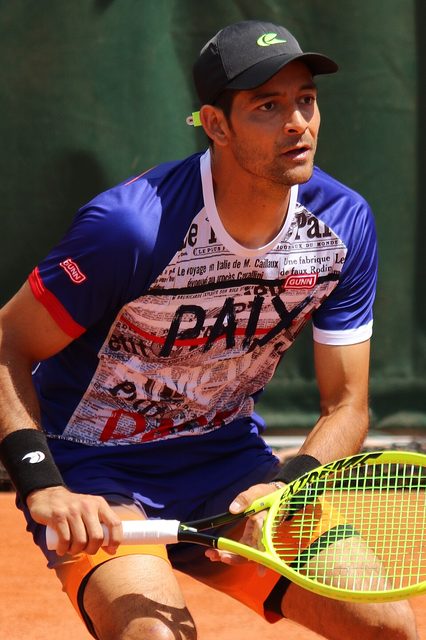
El Salvador · born Sonsonate, 1990 · right-handed · Wimbledon mixed doubles champion 2026 with Jeļena Ostapenko, the first Salvadoran Wimbledon champion
Player from El Salvador to win a Wimbledon title, 2026 mixed with Jeļena Ostapenko
2
Wimbledon finals in the same week of 2026: mixed won, men's doubles lost
3
Major titles: French Open doubles 2022 and 2024, Wimbledon mixed 2026
22-20
Final set of his first Wimbledon doubles win, 2018, over 5 hours 6 minutes and three days
No. 1
Doubles ranking, November 2024, the first Central American to reach it
Playing career
Marcelo Arévalo González was born in Sonsonate, El Salvador, on 17 October 1990 and started playing at eight, following his father, who played at weekends. His older brother Rafael also became a professional and played the 2008 Olympics, where he lost to Roger Federer, Marcelo's idol. Marcelo played two seasons at the University of Tulsa, where he was Conference USA Player of the Year in 2011, turned professional in 2012 and reached No. 139 in singles in 2018, the highest ranking by any Salvadoran player.
Doubles took him further. He broke into the top 100 in 2018 and won his first tour title at Los Cabos that year. In 2022, with Jean-Julien Rojer, he won the French Open, the first Grand Slam title for a Central American, and in 2024 he won it again with the Croatian Mate Pavić, with whom he reached No. 1 in November 2024 and finished the year as the top team. El Salvador named him its sportsman of the year in 2024.
On grass his best summer came in 2026. He and Pavić won Queen's, beating the 2024 Wimbledon champions Harri Heliövaara and Henry Patten 6-2, 6-4 in the final, and at Wimbledon he won the mixed doubles with Jeļena Ostapenko two days before he and Pavić lost the men's doubles final to the same British and Finnish pair.
On grass
Wimbledon mixed 2026
With Jeļena Ostapenko beat Marc Polmans and Storm Hunter 4-6, 7-5, 6-2 on Centre Court in 1 hour 56 minutes, after trailing 3-1 in the second set
Wimbledon doubles 2026
Seeded sixth with Mate Pavić. Quarter-final: beat the defending champions Julian Cash and Lloyd Glasspool. Semi-final: beat Kevin Krawietz and Tim Pütz 7-6 (10-8), 6-2. Final: lost to Harri Heliövaara and Henry Patten 7-6 (4), 7-6 (3), with no break point faced by either side
Wimbledon 2018
First round with Hans Podlipnik-Castillo: beat Jay Clarke and Cameron Norrie 6-4, 6-7 (5-7), 5-7, 6-4, 22-20, 87 games over 5 hours 6 minutes and three days, one of the longest doubles matches in the Championships' record book
Wimbledon 2025
Men's doubles semi-final with Pavić, lost to Rinky Hijikata and David Pel; mixed doubles semi-final with Zhang Shuai, lost to Joe Salisbury and Luisa Stefani
Leading grass titles only: the grass majors, tour-level grass events since 1968 and the leading grass championships before 1968. † single source; ‡ sources disagree. Roll of champions
"It means a lot, coming from El Salvador, a country that is not known for tennis"
Anecdotes
The person behind the player.
Sonsonate
Weekend tennis
He began playing at eight, inspired by his father, Rafael, who played at weekends. His tennis idol is Roger Federer, who beat his brother, also called Rafael, in the second round of the 2008 Beijing Olympics. Away from tennis he likes racing cars and riding motorcycles, and has said he would have liked to be a racing driver.
In two seasons at the University of Tulsa he was Conference USA Freshman of the Year and then, as a sophomore in 2011, Conference USA Player of the Year; his singles win that season clinched Tulsa's first place in the last 16 of the NCAA tournament. His wife, Lucia Kovarcikova, a former Swiss player, also played college tennis, at the University of Utah.
In his Wimbledon doubles debut he and the Chilean Hans Podlipnik-Castillo beat Britain's Jay Clarke and Cameron Norrie 22-20 in the fifth set. The match lasted 5 hours 6 minutes, was played over three days, and is listed in the Wimbledon Compendium among the longest and highest-scoring men's doubles matches ever played there.
After the mixed final he said that becoming a Grand Slam champion was what every child dreams of when starting to play, and that Wimbledon meant more: "It's a lot of history here, like Centre Court. You can feel that aura, that good energy." He added that he wanted to keep inspiring children in El Salvador "to make them believe that when you put a lot of effort and you believe in your dreams, you can achieve big things in life."
Two days later he and Pavić lost the men's doubles final in two tiebreaks to Heliövaara and Patten, whom they had beaten in the Queen's final a few weeks earlier. Arévalo used his runner-up speech to thank the crowd and to congratulate "Henry and Harry for this amazing two weeks, to get a title here again."