Minutes of the 1881 final, the shortest men's final on record
45
Years as vicar of Burneston, North Yorkshire, 1874 to 1919
Playing career
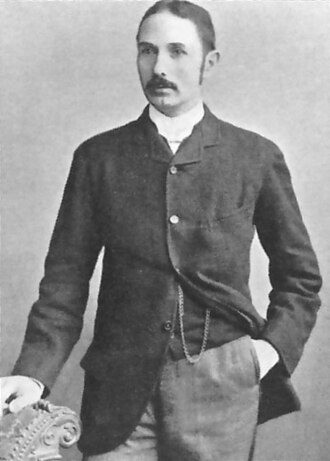
John Thorneycroft Hartley was born on 9 January 1849, the second son of John Hartley, a partner in the Shrubbery Ironworks and mayor of Wolverhampton in 1858, and Emma Thorneycroft, whose father was the town's first mayor. Family research places his birth in Wolverhampton; other accounts give Tong, Shropshire, where his father leased Tong Castle from 1856. He went to Harrow and to Christ Church, Oxford, was ordained priest in 1873 and in 1874 became vicar of Burneston, near Bedale. In 1875 he married Alice Margaret Lascelles Murray, a daughter of the 4th Earl of Mansfield; they had no children.
He took up lawn tennis in his twenties, after moving to Burneston. In 1879 he paid one guinea to enter Wimbledon and won the singles, beating Vere St Leger Goold in the final. In 1880 he beat Herbert Lawford in the Challenge Round to become the first man to retain the title. In 1881, unwell, he lost the Challenge Round to William Renshaw in 37 minutes. He missed 1882 and played his last Wimbledon in 1883, losing in the second round to Herbert Wilberforce.
He gave up serious tennis for the Church: he was Rural Dean of East Catterick from 1891 to 1917 and an honorary canon of Ripon Cathedral from 1905, and he stayed at Burneston until 1919. At the Golden Jubilee Championships in 1926 Queen Mary presented him with a silver medal as one of 34 surviving champions. He died at Knaresborough on 21 August 1935, aged 86, and is buried at Burneston.
On grass
Wimbledon 1879
Final: beat Vere St Leger Goold 6-2, 6-4, 6-2. In the semi-final he lost the first set, out of breath after his journey from Yorkshire, then won the next three 6-0, 6-1, 6-1 after a rain break
Wimbledon 1880
Challenge Round: beat Herbert Lawford 6-3, 6-2, 2-6, 6-3
Wimbledon 1881
Challenge Round: lost to William Renshaw 6-0, 6-1, 6-1 in 37 minutes, the shortest men's final on record; Hartley was reported to be suffering from 'English cholera'
Style
A defensive baseliner who got every ball back, in the words of the historian Richard Hillway; against Goold's net play in 1879 he won with the lob
Leading grass titles only: the grass majors, tour-level grass events since 1968 and the leading grass championships before 1968. † single source; ‡ sources disagree. Roll of champions
"Yes, he was an Irish gentleman, named St Leger. I was given to understand that that was an assumed name. He was a pleasant, typical Irish gentleman of some refinement."
Anecdotes
The person behind the player.
Burneston, July 1879
Sunday services, then the semi-final
Having won through on the Saturday, Hartley took the train home to take the three Sunday services at St Lambert's. A parishioner then took a turn for the worse, and he sat with the man until he died in the early hours of Monday. He collected some sandwiches from his wife, rode to Thirsk station, took the express to King's Cross, a cab to Waterloo and a slow train to Wimbledon, changing into his tennis clothes in the carriage.
He arrived just in time for his semi-final and, out of breath, lost the first set. Then rain stopped play. After the break he won the next three sets 6-0, 6-1, 6-1.
Goold, who had spent the fortnight socialising, rushed the net; Hartley stayed on the baseline and lobbed him, and won 6-2, 6-4, 6-2 in front of 1,100 spectators. He went back to his parish with 12 guineas in prize money and a silver cup worth 25 guineas.
Goold's later life went very differently. In 1907 he and his wife were found guilty of killing a wealthy widow in Monte Carlo. He was sentenced to penal servitude for life and died on Devil's Island, French Guiana, in 1909, aged 54.
Going for a third title, Hartley met William Renshaw in the Challenge Round and lost 6-0, 6-1, 6-1 in 37 minutes, still the shortest men's final on record. It was reported that he was suffering from an attack of 'English cholera'.
Hartley gave up tennis for parish work, but he came back to Wimbledon for the Golden Jubilee Championships in 1926, when Queen Mary presented silver medals to the 34 surviving champions. He was 77.