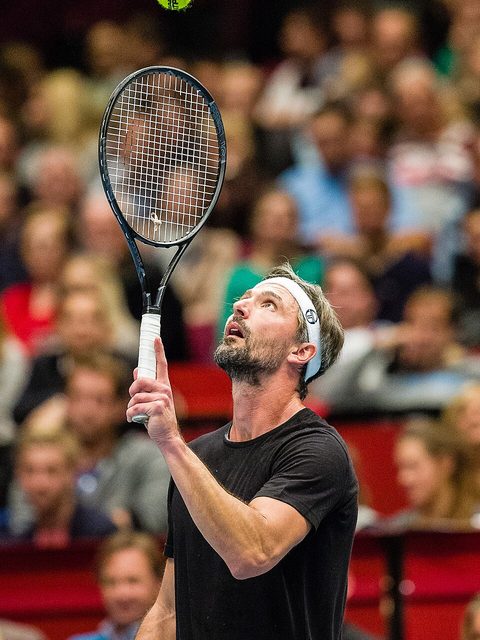
Born in Split on 13 September 1971, Ivanišević was a left-hander with a two-handed backhand who reached No. 2 in the world in July 1994. He won 22 singles titles and nine in doubles, and in 1996 hit 1,477 aces, the most in a season by any player since 1991. He left Yugoslavia's Davis Cup team when Croatia declared independence in 1991, carried Croatia's flag at the 1992 Barcelona Olympics and won bronze there in singles and doubles. Shoulder trouble pushed his ranking down from 1999 to 2001. As a coach he guided Marin Čilić to the 2014 US Open and worked with Novak Djokovic from 2019 to 2024, a period of nine major titles. He entered the Hall of Fame in 2020.
On grass
Wimbledon singles
Champion 2001, as a wild card ranked 125th; runner-up 1992, 1994, 1998
Final won
2001: beat Patrick Rafter 6-3, 3-6, 6-3, 2-6, 9-7 on the third Monday, after a semi-final against Tim Henman that rain spread over three days
Finals lost
1992: to Andre Agassi 7-6 (8), 4-6, 4-6, 6-1, 4-6. 1994: to Pete Sampras 6-7 (2), 6-7 (5), 0-6. 1998: to Sampras 7-6 (2), 6-7 (9), 4-6, 6-3, 2-6
Aces
206 at Wimbledon 1992, a tournament record he broke himself in 2001; 1,377 at Wimbledon in all, a record until Roger Federer passed it in 2019
Other grass
Manchester 1991, beating Pete Sampras in the final. Runner-up at Queen's in 1997 to Mark Philippoussis, and in the Queen's doubles in 1992
Leading grass titles only: the grass majors, tour-level grass events since 1968 and the leading grass championships before 1968. † single source; ‡ sources disagree. Roll of champions
"This is destiny. God wanted me to win this game, he sent the rains."
Anecdotes
The person behind the player.
Brighton 2000
No more rackets
In the second round against Hyung-Taik Lee, ranked 99th, he smashed one racket in the first set, cracked a second in the third and broke the last on the floor. "Gerry, I have no more rackets left," he told the supervisor, Gerry Armstrong, and was defaulted. He predicted he would be remembered as the man who never won Wimbledon but smashed all his rackets.
He described three selves sharing one court: "the good Goran, the bad Goran and the Emergency Goran." Looking back, he thought the idea was quite smart: "I needed something to make me relax and keep me going." Before serving for the title, he said he spoke to every Goran in the world.
His Head Prestige racket made one particular sound when he hit the serve well, and he had not heard it for a long time. "I lost the sound for a year and a half and that [first] Monday I got the sound back," he said. He called his own title an unsolved mystery and asked: "Why do it easy if you can do it the hard way?"
Rain pushed the final to Monday and 10,000 tickets went on a first come, first served basis. Fans camped from Saturday and the queue ran for at least three miles. Centre Court filled with Croatian flags, silly hats and inflatable kangaroos for Rafter. "It was like a football match," Ivanišević said.
Serving for the title at 8-7 in the fifth set, close to tears, he double-faulted three times in the game. On his fourth championship point he knelt and prayed, missed his first serve, and Rafter put the return into the net. Rafter hugged him before he went up to his father in the stands. "This was my dream all my life," he said.
He dedicated the title to the Croatian basketball player Dražen Petrović. On 10 July 2001, the day after the final, around 150,000 people turned out in Split to welcome him home. He was 29, and it was his only major singles title, won at his fourth Wimbledon final.