US singles finals and Challenge Rounds, 1892 to 1896
2
US doubles titles with Clarence Hobart, 1893 and 1894
No. 1
US ranking in 1895
7
Years in the US top ten, 1890 to 1896
Playing career
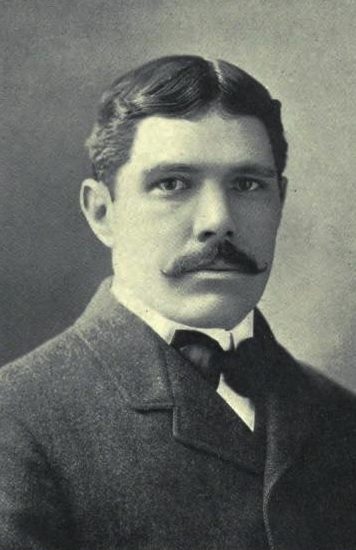
Frederick Howard Hovey was born on 7 October 1868 in Newton Centre, Massachusetts, and went to Harvard. He won the Intercollegiate singles for Harvard in 1890, beating the reigning US champion Oliver Campbell in five sets, and kept the title in 1891. He later went to law school at Harvard.
He won the Longwood Bowl in 1892 and 1893 and was a fixture at the US Championships at Newport. In 1892 he won the right to challenge Campbell and lost the Challenge Round in four sets. In 1893 he lost the final to Robert Wrenn, but with Clarence Hobart he won the US doubles that year and again in 1894. In 1895 he beat Wrenn 6-3, 6-2, 6-4 for the title and was ranked No. 1 in the United States. Wrenn took it back from him in five sets in the 1896 Challenge Round. Hovey was ranked in the American top ten seven times between 1890 and 1896.
He died on 18 October 1945 in Miami Beach, Florida, and was inducted into the International Tennis Hall of Fame in 1974.
On grass
US singles
1892 Challenge Round: lost to Oliver Campbell 5-7, 6-3, 3-6, 5-7. 1893 final: lost to Robert Wrenn 4-6, 6-3, 4-6, 4-6. 1895 Challenge Round: beat Wrenn 6-3, 6-2, 6-4. 1896 Challenge Round: lost to Wrenn 5-7, 6-3, 0-6, 6-1, 1-6
US doubles with Clarence Hobart
1893: beat Oliver Campbell and Bob Huntington 6-3, 6-4, 4-6, 6-2. 1894: beat Carr Neel and Sam Neel 6-3, 8-6, 6-1. 1895: lost to Malcolm Chace and Robert Wrenn 5-7, 1-6, 6-8
Against Wrenn
Three national singles finals in four years, 1893, 1895 and 1896; Hovey won one, in straight sets, and lost the other two, the last in five sets
Leading grass titles only: the grass majors, tour-level grass events since 1968 and the leading grass championships before 1968. † single source; ‡ sources disagree. Roll of champions
"Our double champions in 1894, C. Hobart and F. H. Hovey, are past-masters of this art, which makes their game a brilliant one to watch."
Anecdotes
The person behind the player.
New Haven, October 1890
Fifty games against the champion
In the Intercollegiate final at New Haven he beat Oliver Campbell of Columbia, the US champion, 6-4, 4-6, 7-5, 2-6, 6-4. The Harvard Crimson noted that it took five sets and fifty games, 25 each, and that Hovey made "a number of seemingly impossible returns of long, high hit balls".
A year later he defended the Intercollegiate title, beating Lee of the University of Pennsylvania 6-4, 6-2, 6-2. The Crimson observed that Harvard had begun the previous college year by winning the tennis championship and had begun this one the same way.
Hovey and Wrenn had met in the 1893 final, which Wrenn won in four sets. Hovey won the 1895 meeting for the loss of nine games. The Hall of Fame calls the 1896 Challenge Round the rubber match between the two rivals; Wrenn won a topsy-turvy contest in which the sets went 7-5, 3-6, 6-0, 1-6, 6-1.
When Scribner's published its Out of Door Library volume on athletic sports, the lawn tennis chapter was written by Wrenn, signed as champion of 1896, the year he beat Hovey. In it he picked out Hovey and Hobart, the 1894 doubles champions, as masters of the quick-wristed volley that ends a rally.
His older brother, George Rice Hovey, a Brown baseball player, became a professor at Virginia Union University in 1899 and lent his own money to fence its athletic ground. The field was named Hovey Field, and in 2011 it was still the university's football stadium. Virginia Union's history of the field notes that Fred won the US title in 1895 and was inducted into the Collegiate Tennis Hall of Fame in 1998.