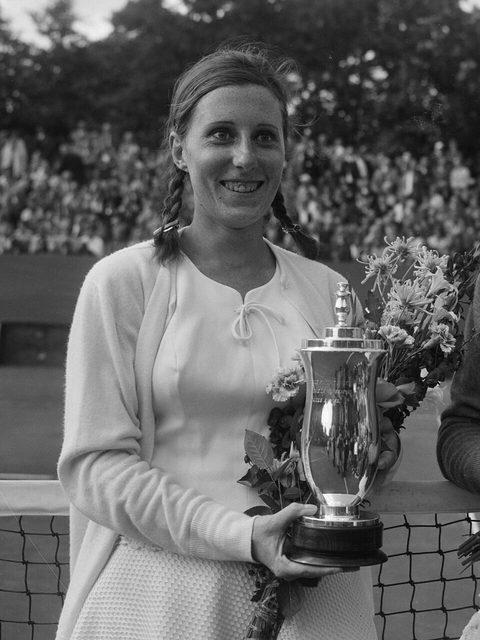
Wimbledon mixed doubles title with Tony Roche, after saving a match point
6
Wimbledon ladies' doubles finals, 1965 to 1975, all lost
2
US Open doubles titles on the Forest Hills grass, 1969 and 1972
164
Matches played at Wimbledon, 1963 to 1979
1970
Wimbledon singles semi-final as an unseeded player
Playing career
Françoise Dürr was born in Algiers on 25 December 1942 and learned the game in Oran, where her father, an army officer, played at the local club. With no coach at first, she developed an unorthodox grip with her index finger flat along the handle and a backhand hit with a bent wrist, and she kept both throughout her career. She first played Roland Garros in 1960 and the first Federation Cup in 1963.
In 1967 she won the French Championships, beating Maria Bueno, Kerry Melville and Lesley Turner, and rose to No. 3 in the world. She reached four more major singles semi-finals, including Wimbledon in 1970, and won 26 singles titles; on grass these included Queen's Club in 1966 and Eastbourne in 1972. In 1968 she was one of the first four women to sign professional contracts, with George MacCall's National Tennis League, and in 1971 she played the first Virginia Slims events.
Doubles was her speciality. She won the French women's doubles five years running from 1967 to 1971, the US Open doubles in 1969 with Darlene Hard and in 1972 with Betty Stöve, and three French mixed titles with Jean-Claude Barclay. At Wimbledon she lost six ladies' doubles finals, five of them to pairs including Billie Jean King, before winning the mixed with Tony Roche in 1976.
In 1973 she was a founding co-secretary of the WTA. She later lived in the United States, then returned to France, where she was the French federation's technical director for women's tennis from 1993 to 2002 and, with Yannick Noah, co-captained France to its first Fed Cup title in 1997. She was inducted into the International Tennis Hall of Fame in 2003.
On grass
Wimbledon 1976 mixed final
Unseeded with Tony Roche, beat Dick Stockton and Rosie Casals 6-3, 2-6, 7-5 after being a match point down at 4-5 in the third set
Wimbledon doubles finals
1965 with Janine Lieffrig, lost to Maria Bueno and Billie Jean Moffitt 2-6, 5-7. 1968 with Ann Jones, lost to Rosie Casals and Billie Jean King 6-3, 4-6, 5-7. 1970 with Virginia Wade, lost to Casals and King 2-6, 3-6. 1972 with Judy Dalton, lost to King and Betty Stöve 2-6, 6-4, 3-6. 1973 with Stöve, lost to Casals and King 1-6, 6-4, 5-7. 1975 with Stöve, lost to Ann Kiyomura and Kazuko Sawamatsu 5-7, 6-1, 5-7
US Open doubles, Forest Hills
1969 with Darlene Hard beat Margaret Court and Virginia Wade 0-6, 6-3, 6-4. 1972 with Betty Stöve beat Court and Wade 6-3, 1-6, 6-3. Finals lost in 1971 and 1974
Wimbledon singles
Won the Plate in 1963, beating A. Dimitrieva 6-1, 6-3. Unseeded semi-finalist in 1970, beaten by Billie Jean King
Wimbledon record
Singles 35-17, doubles 51-17, mixed 29-15, from 1963 to 1979
Leading grass titles only: the grass majors, tour-level grass events since 1968 and the leading grass championships before 1968. † single source; ‡ sources disagree. Roll of champions
"My big strength was my physical conditioning and tenacity, and with my funny grip a lot of people could not read me well."
Anecdotes
The person behind the player.
Centre Court
Shocking, my dear
Ted Tinling designed her a backless halter dress, which caused a stir when she took off her sweater on Centre Court. She recalled it years later: "Teddy had made me a halter backless dress", and called it shocking.
In 1972 she bought an Airedale terrier and named him Topspin. He carried her racquets on court and became the first pet allowed in the players' dressing room; he later served as mascot of the Denver Racquets in World TeamTennis.
The early Virginia Slims events began with 16 players and no reserves. To draw a crowd, she recalled, "I remember standing at the entrance of a supermarket in Detroit with Billie Jean King and Betty Stove," handing out free tickets.
Too young to be allowed on the club courts in Oran, she practised against the club and garage walls. Without a coach she found her own grip: "I could not feel the ball on the racquet, so I kept the same grip."
In the 1967 French final she trailed Lesley Turner 2-4 in the third set and won 4-6, 6-3, 6-4. Her coach's advice had been to fight, since she might never reach another Grand Slam final.
She met her husband, Boyd Browning, while playing World TeamTennis in Denver. They married in 1975, and she lived in the United States before returning to France with their two children.