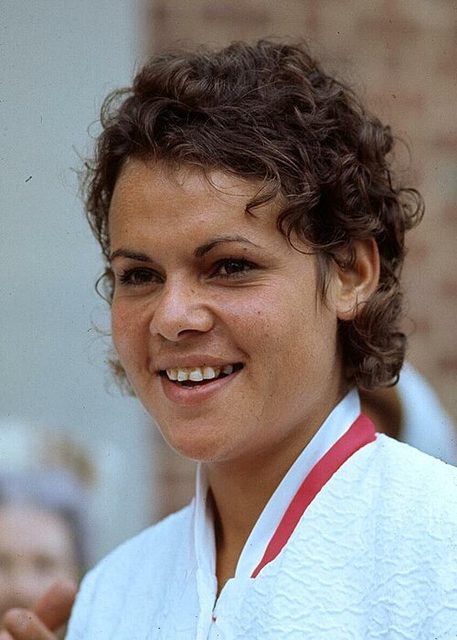
Born in 1951 into a Wiradjuri family of eight children, Goolagong grew up in Barellan, New South Wales, and moved to Sydney in 1965 to be coached by Vic Edwards. In 1971, aged 19, she won the French Championships at her first attempt and then Wimbledon, beating Margaret Court in the final. She won seven major singles titles in all: two at Wimbledon, four at the Australian Open and the 1971 French. She helped Australia win the Federation Cup in 1971, 1973 and 1974, married Roger Cawley in 1975, and in 1980 became the first mother to win Wimbledon since 1914. In 2007 a review of the records showed that she had been world No. 1 for two weeks in 1976. She entered the International Tennis Hall of Fame in 1988.
On grass
Major singles titles
6: Wimbledon (1971, 1980); Australian (1974, 1975, 1976, 1977)
Major singles finals lost
8: Wimbledon 1972, Wimbledon 1975, Wimbledon 1976, Australian 1971, Australian 1972, Australian 1973, US 1973, US 1974
Leading grass titles only: the grass majors, tour-level grass events since 1968 and the leading grass championships before 1968. † single source; ‡ sources disagree. Roll of champions
"She didn't serve-and-volley, she would sort of saunter-and-volley."
Anecdotes
The person behind the player.
Barellan, 1950s
A princess at Wimbledon
She found tennis through a story in a girls' magazine about "a princess who goes to this magical place called Wimbledon." With a slat from an apple crate she hit rubber balls against walls and chimneys around a town where her family's house had no electricity.
She first practised with a stringless racquet made from a fruit box and watched the game through the fence of the Barellan War Memorial Tennis Club. The club president, Bill Kurtzman, saw her there and invited her in to play. The Hall of Fame suggests her career might not have happened without that offer.
At 19 she met Margaret Court, the defending champion, in the final and beat her 6-4, 6-1. "To beat Margaret Court ... I was over the moon about winning," she said. Weeks earlier she had won the French Championships at her first attempt; Wimbledon made it two major titles in one summer.
Her occasional lapses of concentration gave rise to the saying that Evonne had "gone walkabout", and she spoke about them without embarrassment. Margaret Court saw the other side of it: "She can be down love-40, apparently beaten, and she's still trying to hit winners."
She beat Chris Evert 6-1, 7-6 in the final, with her husband and young daughter watching, and became the first mother to win Wimbledon since Dorothea Lambert Chambers in 1914. The nine years between her two titles matched the longest gap, set by Bill Tilden. She called it the crowning moment of her career.
As children she and her siblings hid under the beds when unfamiliar cars came by. Only later did she understand that this was linked to the removal of Aboriginal children from their families. After her mother's death in 1991 she set out to trace the family's past: "I was so hungry to learn my history, to really know who I was."