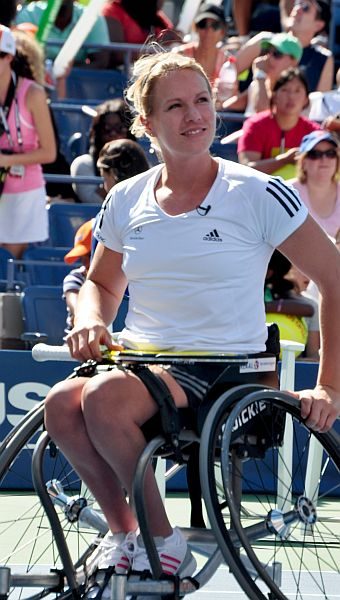
Born in Woerden in 1981, Vergeer began using a wheelchair as a child and first played wheelchair basketball, winning the 1997 European title with the Dutch team. The national tennis coach told her she had a talent for tennis, and in 1998 she chose it. She was world No. 1 in singles from April 1999 until her retirement, 668 weeks in all, and won 21 major singles titles, nine at the Australian Open and six each at the French and US Opens. At the Paralympics she won four singles golds from Sydney to London and three in doubles. After a defeat in January 2003 she won 470 singles matches in a row and retired unbeaten in February 2013. She won the Laureus award in 2002 and 2008 and entered the International Tennis Hall of Fame in 2023.
On grass
Major doubles titles
3: Wimbledon (2009, 2010, 2011)
Wimbledon doubles
2009 with Korie Homan, in the first ladies' wheelchair doubles; 2010 and 2011 with Sharon Walraven
Wimbledon doubles finals
2009: beat Daniela di Toro and Lucy Shuker 6-1, 6-3. 2010: beat di Toro and Shuker 6-2, 6-3. 2011: beat Jiske Griffioen and Aniek van Koot 6-4, 3-6, 7-5
Wimbledon singles
No event during her career; the wheelchair singles began in 2016, three years after she retired
Leading grass titles only: the grass majors, tour-level grass events since 1968 and the leading grass championships before 1968. † single source; ‡ sources disagree. Roll of champions
"I would have loved to play singles there. I was convinced that I could do it, but the organization wouldn't let me."
Anecdotes
The person behind the player.
Netherlands, 1998
Basketball or tennis
In her teens Vergeer played wheelchair basketball for the Netherlands as well as tennis. The national tennis coach told her: "you have talent for tennis, maybe you should focus on that." When she started university in 1998 she had to choose, and picked tennis, she said, because she was "more of an individual athlete than a team athlete".
Her last singles loss came against the Australian Daniela di Toro on 30 January 2003. Vergeer later said di Toro had "just totally overpowered" her. She did not lose another singles match for ten years. The run, she admitted, sometimes gave her confidence and sometimes "a lot of pressure", because everybody expected her to win.
In the Paralympic singles final her compatriot Korie Homan held match point before Vergeer won 6-2, 4-6, 7-6 for a third successive gold. A day later Homan and Sharon Walraven beat Vergeer and Jiske Griffioen in the doubles final. A year on, Vergeer and Homan won the first Wimbledon ladies' wheelchair doubles together.
The All England Club added a ladies' wheelchair doubles in 2009. Vergeer and Korie Homan won the first final 6-1, 6-3 against Daniela di Toro and Lucy Shuker. She defended the title in 2010 with Sharon Walraven against the same opponents, and won a third in 2011, 7-5 in the final set against Jiske Griffioen and Aniek van Koot.
In 2010 she posed for ESPN The Magazine's Body Issue, the first disabled athlete to appear in it. By then she had won both her Laureus awards for sportsperson of the year with a disability, in 2002 and 2008, after six nominations, and was seven years into her unbeaten run.
A year earlier she had said she would know when it was time to stop. Months after her fourth Paralympic singles gold in London, she did: "After winning so many matches and so many competitions, I thought, maybe it is time to retire and use my knowledge and my experience and go for some other challenges." She later advised the Dutch Paralympic Committee.