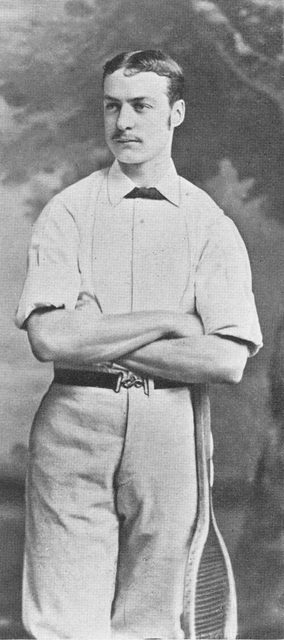
Wimbledon gentlemen's doubles title with Harry Barlow
4
Wimbledon All Comers' singles finals, 1886, 1888, 1892 and 1894, all lost
6
Wimbledon doubles finals, All Comers' or Challenge Round, 1884 to 1895
2
Irish singles titles, 1890 and 1891
3
South of England singles titles at Eastbourne in a row, 1885 to 1887
Playing career
Ernest Wool Lewis was born in Hammersmith on 5 April 1867. The Badminton Library recorded his first tournament successes in 1882, when he was 15, and by 1884 he and E.L. Williams were playing the Renshaw twins in the Wimbledon doubles. He won the South of England singles at Eastbourne three years running from 1885 to 1887, and in 1886 beat Ernest Renshaw at Wimbledon on his way to the All Comers' final, which he lost in five sets to Herbert Lawford.
For the next eight years he was among the best players in England without winning the singles title. He lost the All Comers' final again in 1888 to Ernest Renshaw, in 1892 to Joshua Pim after leading by two sets to love, and in 1894 to Wilfred Baddeley. He won the Irish singles at Fitzwilliam in 1890 and 1891 and the London Championships at Queen's Club in 1892, and indoors he was almost unbeatable on the wood of the Hyde Park and Queen's covered courts, winning the Covered Court Championship seven times between 1887 and 1896.
His one Wimbledon title came in doubles. In 1892, with Harry Barlow, he beat Harold Mahony and Pim in a five-set All Comers' final and then the holders, Herbert and Wilfred Baddeley, 4-6, 6-2, 8-6, 6-4. He reached the Challenge Round again in 1893 with Barlow and in 1895 with Wilberforce Eaves.
After his playing days he joined Roehampton Club in 1919, captained its lawn tennis team and chaired its lawn tennis committee for at least five years. He died in Plymouth on 19 April 1930, aged 63.
On grass
Wimbledon All Comers' finals
1886: lost to Herbert Lawford 2-6, 3-6, 6-2, 6-4, 4-6. 1888: lost to Ernest Renshaw 9-7, 1-6, 6-8, 4-6. 1892: lost to Joshua Pim 6-2, 7-5, 7-9, 3-6, 2-6. 1894: lost to Wilfred Baddeley 0-6, 1-6, 0-6
Wimbledon doubles 1892
With Harry Barlow beat Harold Mahony and Joshua Pim 8-10, 6-3, 5-7, 11-9, 6-1 in the All Comers' final, then Herbert and Wilfred Baddeley 4-6, 6-2, 8-6, 6-4 in the Challenge Round
Other Wimbledon doubles finals
1884: All Comers' final with E.L. Williams, lost to the Renshaws. 1889: Challenge Round with George Hillyard, lost to the Renshaws 4-6, 4-6, 6-3, 6-0, 1-6. 1890: All Comers' final with Hillyard, lost to Pim and Frank Stoker. 1893: Challenge Round with Barlow, lost to Pim and Stoker 6-4, 3-6, 1-6, 6-2, 0-6. 1895: Challenge Round with Wilberforce Eaves, lost to the Baddeleys 6-8, 7-5, 4-6, 3-6
Irish Championships
Singles 1890 and 1891; doubles 1889 with George Hillyard, beating the Renshaws, and 1892 with Ernest Meers; mixed 1888 with Margaret Bracewell
Eastbourne
South of England singles 1885, 1886 and 1887, and doubles 1885 with R.M. Watson
Leading grass titles only: the grass majors, tour-level grass events since 1968 and the leading grass championships before 1968. † single source; ‡ sources disagree. Roll of champions
"Capable of making every stroke that can be made on a lawn tennis court, and also of many that would seem impossible"
Anecdotes
The person behind the player.
Wimbledon 1892
One of the finest matches
Lewis led Joshua Pim by two sets to love in the 1892 All Comers' final and lost 2-6, 5-7, 9-7, 6-3, 6-2 after 110 minutes. The All England Club's own history calls it one of Wimbledon's finest-ever matches, played in front of an excited crowd.
H.S. Scrivener recalled that Lewis preferred knickerbockers on court. When he turned out in trousers it was a sure sign he did not expect a hard match, so Scrivener was "greatly overjoyed" to see the knickers when he first met him in a Wimbledon single in 1888.
The covered court at the Hyde Park club, of narrow boards laid like a ship's deck, had a corner with too little run-back that defeated most visitors. Lewis would simply half-volley the ball back from it. He won the Covered Court Championship seven times, five at Hyde Park and the last two at Queen's.
With the baseliner H. Chipp he formed a successful pair on the tournament circuit. Scrivener compared them to the doubles champions of 1902 and 1906: Chipp thundered from the back of the court while Lewis "fluttered about up at the net and made a dart for everything that came within reach."
In 1889 Lewis and George Hillyard beat the Renshaw twins in the Irish doubles at Dublin. Shortly afterwards they met again in the Wimbledon Challenge Round, and the Renshaws kept their title only by the odd set in five.
In June 1919 he joined Roehampton Club. That November the lawn tennis committee asked him to be Match Captain for 1920, for fixtures against Oxford, Cambridge, Queen's Club and Surbiton, and from October 1920 he chaired the committee for at least five years.