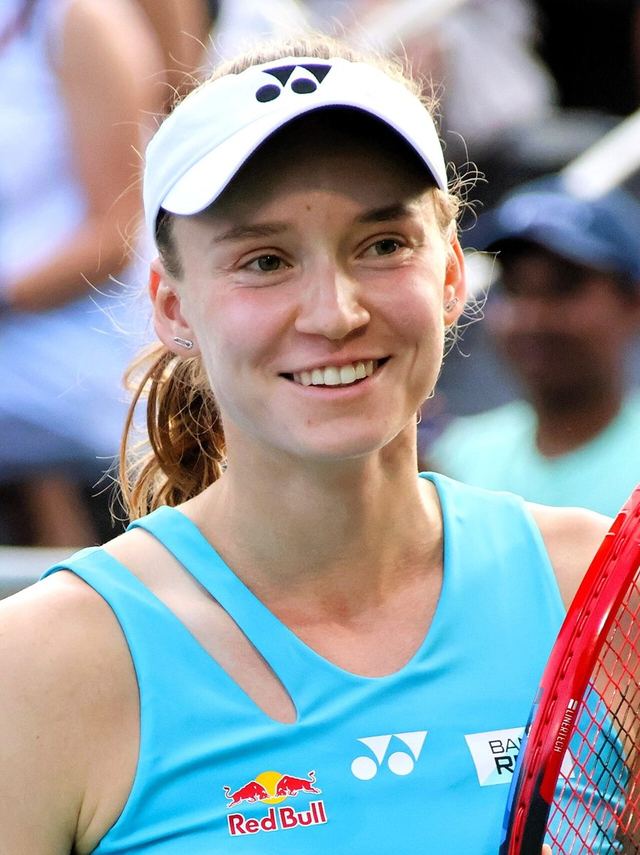
Born in Moscow on 17 June 1999, Rybakina was a gymnast and figure skater as a child before taking up tennis. In May 2018, just after turning 19, she switched from Russia to Kazakhstan, whose federation offered her financial support. She won her first WTA title in Bucharest in 2019, reached the 2021 French Open quarter-finals by beating Serena Williams, and won Wimbledon in 2022. She reached the 2023 Australian Open final and won the 2025 WTA Finals unbeaten. In 2026 she beat Aryna Sabalenka in the finals of the Australian Open and the US Open, and on 14 September became the first player from Kazakhstan to reach world No. 1. Her 2026 grass season brought a quarter-final at Queen's, an opening defeat in Berlin and a third-round loss at Wimbledon as second seed.
On grass
Wimbledon singles
Champion 2022. Lost in qualifying 2019; fourth round 2021; quarter-final 2023; semi-final 2024; third round 2025 and 2026
Wimbledon final
2022: beat Ons Jabeur 3-6, 6-2, 6-2, the first woman to win the final from a set down since Amélie Mauresmo in 2006. Ranked 23rd, she was the lowest-ranked champion since Venus Williams, No. 31, in 2007
Grass titles
Wimbledon 2022, her only title on the surface and the first major for Kazakhstan
Wimbledon defeats
2021: Aryna Sabalenka, fourth round. 2023: Ons Jabeur, quarter-final, in three sets. 2024: Barbora Krejčíková, semi-final, in three sets. 2025: Clara Tauson, third round. 2026: Elise Mertens, third round, 7-6 (4), 6-1
Other grass events
Semi-finals at 's-Hertogenbosch 2019 and Eastbourne 2021; quarter-finals in Berlin 2024 and 2025 and at Queen's 2025 and 2026
Leading grass titles only: the grass majors, tour-level grass events since 1968 and the leading grass championships before 1968. † single source; ‡ sources disagree. Roll of champions
"Maybe because she's shy and she doesn't show her personality, I think her game speaks for her."
Anecdotes
The person behind the player.
Moscow, 2000s
Told she was too tall
As a child in Moscow, Rybakina was a gymnast and an ice skater before she turned to tennis, and was told her height would stop her succeeding as a professional. The height later became the base of a serve that led the tour in aces in the year she won Wimbledon.
Jabeur waved to the crowd as they walked on; Rybakina kept both hands on the straps of her racquet bag. At match point there were no screams and no collapse onto the grass, only a raised arm. Jabeur promised afterwards to teach her how to celebrate.
Rybakina said later that she was so much in shock at the trophy presentation that she did not hear half of what the Duchess of Cambridge said to her. She had not expected to reach the second week of the tournament, let alone the final weekend.
Two hours after the final, asked whether her parents would be proud, she began to cry and joked with reporters: "You wanted to see emotion! I kept it too long." Questions about her Moscow birth followed, and she answered simply: "I didn't choose where I was born."
Seeded second, she lost in the third round to Elise Mertens, 7-6 (4), 6-1, landing 42 per cent of her first serves and hitting six double faults. She did not hide from it: "the first serve was not really working for me today." Two months later she won the US Open and became world No. 1.