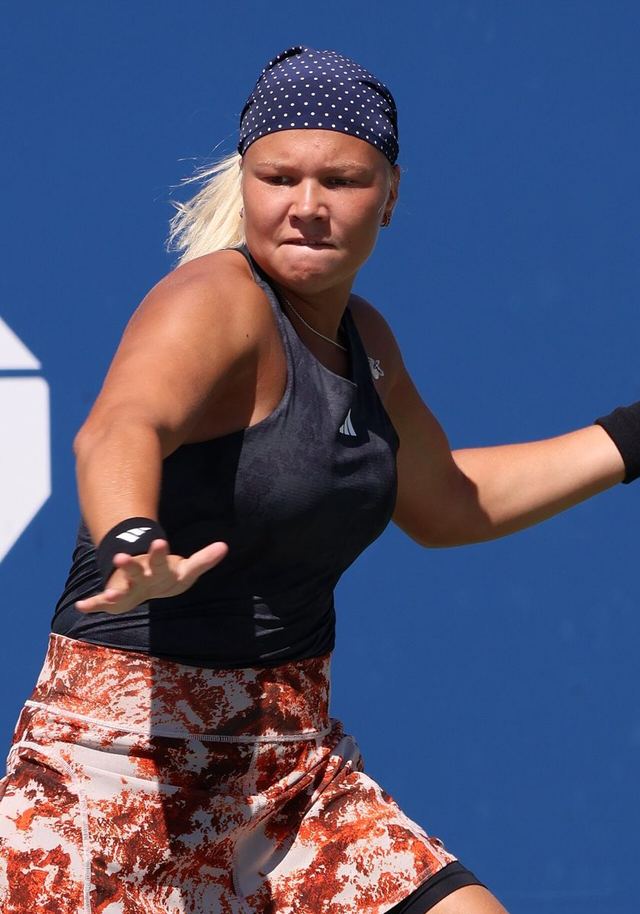
Born in Zhigulevsk, Russia, on 2 April 2004, Shnaider moved to Moscow at about eight to train. As a junior she won the Wimbledon girls' doubles in 2021. She spent the 2023 season at North Carolina State University, winning 20 of 23 singles matches, then turned professional that summer. In 2024 she won four WTA singles titles, at Hua Hin, Bad Homburg, Budapest and Hong Kong, and an Olympic silver medal in doubles with Mirra Andreeva in Paris. A fifth singles title followed at Monterrey in 2025, the year she reached a career-high No. 11, and in 2026 she made her first major semi-final at the French Open, beating Aryna Sabalenka on the way. On grass in 2026 she lost her opening matches in Berlin and Bad Homburg, then won one match at Wimbledon before losing to Liudmila Samsonova.
On grass
Wimbledon singles
Third round 2024; second round 2025 and 2026; lost in qualifying 2023
Wimbledon 2024
Beat Karolína Plíšková 4-6, 6-4, 7-5 and Sloane Stephens 6-1, 6-1, then lost to the 19th seed Emma Navarro 6-2, 3-6, 4-6
Grass titles
Bad Homburg 2024, unseeded on her debut at the event, beating Angelique Kerber, Dayana Yastremska, Paula Badosa, Emma Navarro and, in the final, Donna Vekić 6-3, 2-6, 6-3
Wimbledon girls' doubles
Champion 2021 with Kristina Dmitruk, beating Sofia Costoulas and Laura Hietaranta 6-1, 6-2 in the final
Other grass events
Queen's 2025: singles quarter-final, lost to Madison Keys in three sets; doubles runner-up with Anna Danilina
Leading grass titles only: the grass majors, tour-level grass events since 1968 and the leading grass championships before 1968. † single source; ‡ sources disagree. Roll of champions
"I don't mind grass at all. My game is pretty good on the surface."
Anecdotes
The person behind the player.
Russia, childhood
The supermarket headscarf
Her parents worried that she would burn in the sun, and caps and visors blocked her view of the ball toss, so she played in a scarf bought at a supermarket. Some juniors told her it did not suit her. At Wimbledon qualifying in 2023 she played bare-headed because she could not find a good all-white one, and she now buys the material and has them made to measure.
After a breakthrough in Australia she still went back to NC State for her freshman season. As a Russian player she had no coach, no training base and little financial backing, and college offered both coaching and courts. The deal with her coaches was one year: if she neared the top 100, they would let her turn professional. "I improved a lot in college," she said.
At 17 she won the girls' doubles at Wimbledon with Kristina Dmitruk of Belarus, beating Sofia Costoulas and Laura Hietaranta 6-1, 6-2 in the final. Later that year she added the Orange Bowl girls' doubles with Petra Marčinko and finished the season ranked No. 3 in the combined junior rankings.
She arrived at Bad Homburg ranked 47 and, by her own account, believing grass was not her surface. She left with the title and a ranking of 30. Two months later she said the week had been "unbelievable because I thought I wasn't that good on grass". On the day she called it one of the best weeks of her life.
As a child she tried classical dance, piano and chess alongside tennis before the tennis "slowly" took over. A chess set travelled with her and her father to junior tournaments so they could play between matches. At 14 or 15, with no fitness coach, she took up boxing for conditioning: "It's really fun, really hard."