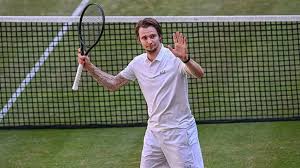
Alexander Bublik is the most unorthodox server among the leading grass players, a two-time Halle champion whose game runs on free points, sudden changes of pace and drop shots that die on the low bounce. He finished the 2026 season 5th in the men’s GTC Grass Rankings with a GTC Grass Rating of 118, the same place he held before the swing began.
Grass at a glance
- GTC Grass Rating: 118, 5th in the men’s rankings (5th before the season)
- Pillars: Lawn Form 74, Arsenal 88, Wimbledon 58, Nerve 64
- Nationality: Kazakhstan
- Best Wimbledon result: Fourth round (2023, 2026)
- Grass titles: Halle 2023, Halle 2025
- Plays: Right-handed, two-handed backhand
How Alexander plays on grass
Bublik’s serve is the base of everything. He mixes a heavy first serve with second serves hit almost as hard, and he will use an underarm serve when a returner drifts too far back. On grass that variety is worth more than raw pace, because the returner never settles into a rhythm. His Arsenal score of 88 is the highest of his four pillars and reflects how often he ends points inside three shots.
From the back he plays a flat, risky game, flattening the forehand and taking the backhand early. He is comfortable moving forward and uses the drop shot more than almost anyone on the tour, which works well on a surface where the ball stays low after the bounce. His movement is better than his languid style suggests, though he defends by anticipation rather than speed.
The weakness grass exposes is concentration. Sets can drift when the free points stop, and a tie-break can turn on one loose game. His Nerve score of 64 reflects a mixed record in those moments: he can win long five-setters, but he can also lose a tie-break from a strong lead, as he did in Halle this year.
Grass record
Halle is where Bublik has built his grass reputation. He won the title in 2023, beating Andrey Rublev 6-3, 3-6, 6-3 in the final, and won it again in 2025 with a 6-3, 7-6(4) win over Daniil Medvedev. Those two titles at an ATP 500 event account for most of his Lawn Form score.
Wimbledon has been less productive. His best run before 2026 was the fourth round in 2023, where Rublev beat him, and that gap between his Halle results and his Wimbledon record explains a Wimbledon pillar of 58.
The 2026 grass season
The season began in Stuttgart, where Bublik was the 3rd seed and reached the semi-final before Taylor Fritz beat him 6-4, 6-4. That run nudged his rating from 117 to 118. In Halle he arrived as defending champion and lost in the first round to Mattia Bellucci, 7-6(6), 6-1, after leading 6-3 in the first-set tie-break. Bellucci saved three set points and Bublik did not recover. The rating held at 118.
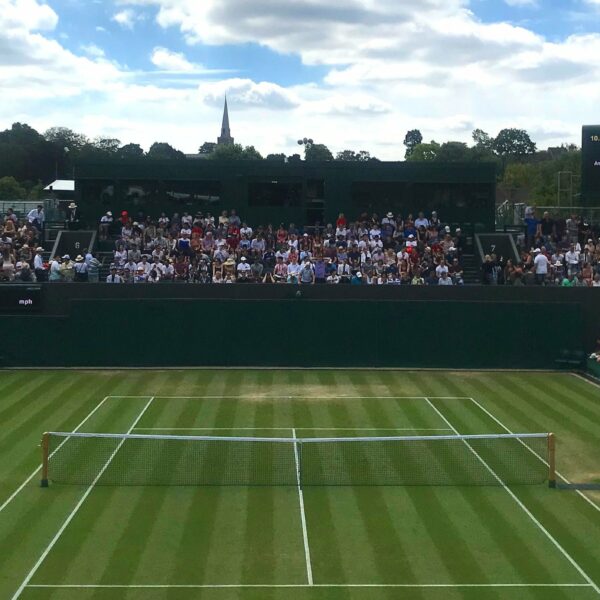
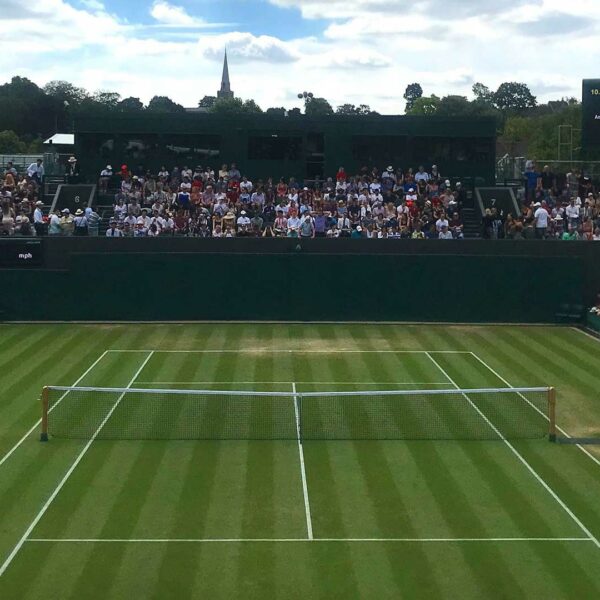
Bublik was entered at Mallorca but withdrew before the event and did not play again until Wimbledon. Seeded 10th there, he beat Kyrian Jacquet in straight sets and Thanasi Kokkinakis in five, then beat Frances Tiafoe 4-6, 7-6(5), 7-6(11), 4-6, 6-3 in a third-round match of about four hours. Fritz ended the run again in the fourth round, winning 7-6(1), 6-4, 6-4 on Court One. Bublik finished the season at 118, matching his best Wimbledon result.
Looking ahead to 2027
Halle will again set the tone for his summer, and a likely schedule of Stuttgart or ‘s-Hertogenbosch, then Halle, then Wimbledon suits a player who needs matches to find his timing. The figure to improve is the Wimbledon pillar. Two fourth-round finishes and no quarter-final leave him well short of what his serve should produce over best-of-five sets, and both 2026 defeats to Fritz came against a player who returned his serve with patience. A realistic target for 2027 is a third Halle final and a first Wimbledon quarter-final, which would push his rating into the low 120s.